Midwest: Great Lakes golfers
When a Frost Delay Changes Your Midwest Practice Plan
If a course delays play, respect its instructions. Use available indoor time to review missing card details, keeping that session separate from the postponed outdoor check.
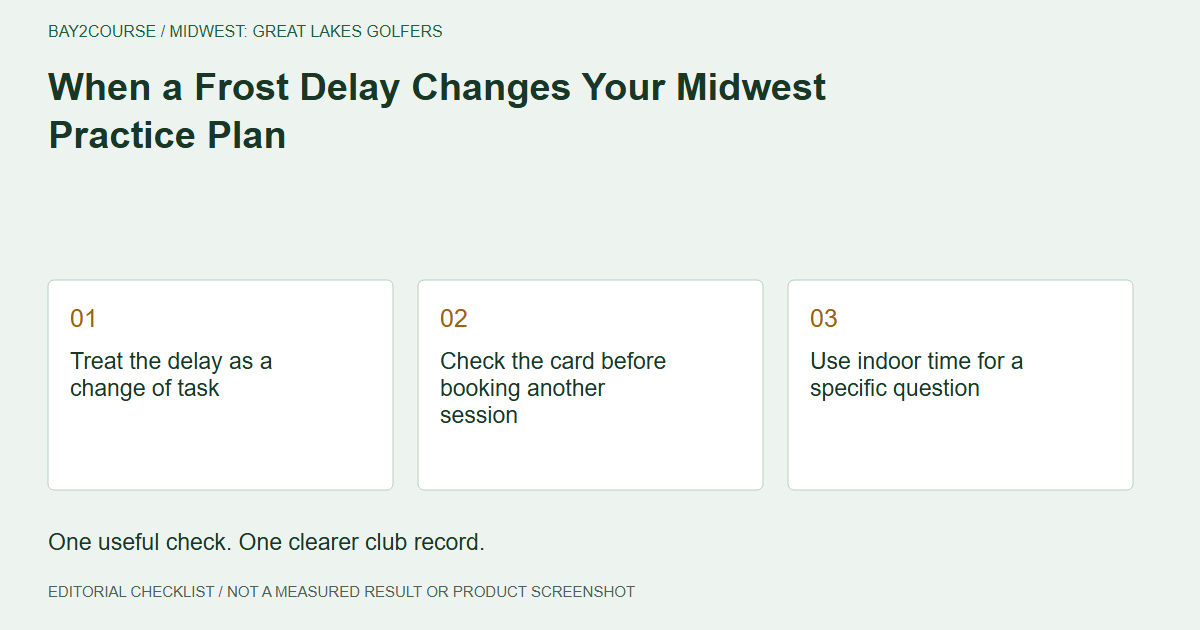
Treat the delay as a change of task
A frost delay can interrupt a Great Lakes golfer's autumn plan without making the available time worthless. The USGA identifies frost delays as a familiar part of fall golf. That seasonal observation does not tell you whether your own course will delay play today.
If the operator postpones access, follow its instructions. Do not move onto another part of the property because it looks usable. Start by asking what is available, then choose a card-review task that does not depend on entering closed turf.
Check the card before booking another session
Open the club entry you intended to check outdoors and identify the missing information. Is the simulator result clearly labeled carry? Are the units understood? Do you have the source report? These questions may be answerable without hitting another ball.
A second indoor session is not automatically the best use of a delay. If the real problem is a missing metric label, repeating the process could produce another poorly documented number. Resolve the source question first so any later practice has a clear purpose.
Use indoor time for a specific question
If an indoor facility is available and you choose to practice, decide what you want to record before the session begins. Perhaps the task is to obtain a clearly labeled entry for one club. Keep the new session's identity separate from the course check that did not happen.
Do not mark the outdoor question finished merely because you completed an indoor task. The two records may eventually be useful together, but they are different evidence. In your own review worksheet, describe one as deferred and the other as source clarification or new simulator work.
Keep the short note honest
A note such as 'Frost delay; outdoor check deferred' fits within 50 characters and explains the interruption. If you also gather new simulator information, preserve its longer context in your personal session record rather than trying to squeeze both events into an ambiguous sentence.
Review any coach question you brought to the course. You may be able to refine it while waiting, even without a new shot. Asking what observation would be useful next is more productive than attaching an explanation to an event that never occurred.
Return only after local confirmation
Check with the course before restarting the outdoor plan. Neither the regional season nor the passage of a certain number of minutes establishes that access has reopened. If the remaining opportunity is unsuitable, leave the course question unresolved and choose another decision point.
The useful outcome is a clearer next action. You might leave with the original report found, a source label confirmed, or a coach question ready to share. None is outdoor proof, but each can make the next permitted course check easier to interpret.
A worked example
DEMO - fictional tasks during a delayed outing.
| Task | What it establishes |
|---|---|
| Confirm report label | Better source context |
| Review coach question | Clearer next action |
| New indoor session | Separate simulator evidence |
| Deferred course check | No new outdoor observation |
Common questions
Can I use an indoor session to replace the delayed check?
You can choose indoor practice instead, but it answers a different question. Record it as simulator work and keep the planned course observation deferred until an actual suitable opportunity occurs.
Does a frost delay mean the outdoor season is over?
No regional conclusion follows from one operator's delay. Check current local conditions and the course's schedule. Historical or seasonal patterns are planning context, not a forecast of future access.
Sources and further reading
Primary references behind this guide. Local course instructions and current weather take priority over seasonal averages.
Written by Bay2Course, the maker of the app. This is practical record-keeping guidance, not independent equipment testing or a claim of professional coaching credentials. How we prepare and correct guides.
Explore: how it works · for venues