Midwest and Northeast
Wet Fall Fairways: Keep Landing and Roll Notes Separate
A final resting position is not the same observation as first landing. Keep surface notes separate and avoid using a short finish alone to rewrite simulator carry.
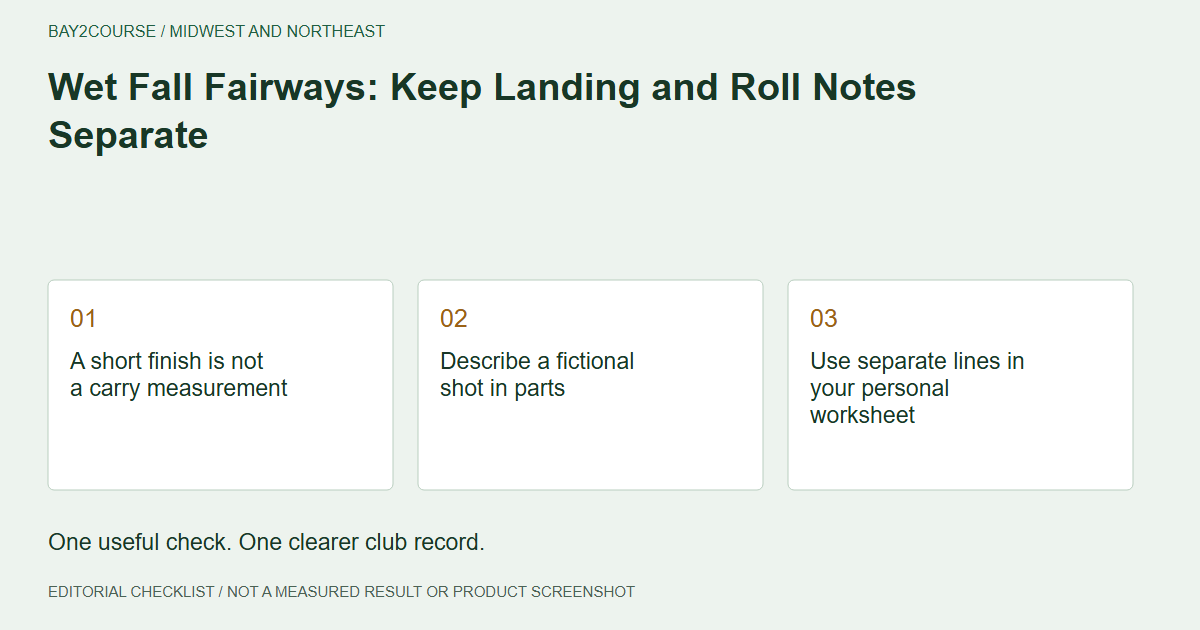
A short finish is not a carry measurement
A ball that finishes short on a damp autumn fairway does not, by itself, show how far it carried. Separate the first landing from the final position before deciding what the shot adds to your club card. You may know one, both, or neither with useful precision.
For Midwest and Northeast golfers reviewing fall rounds, that distinction prevents a surface observation from becoming an unsupported distance rule. Record the actual fairway condition you encountered. Do not assume all regional courses are wet simply because it is autumn.
Describe a fictional shot in parts
Imagine a fictional approach that lands out of view and is later found short of the intended area. The golfer notices damp ground near the ball. The reliable account is that the finish was short and the nearby ground was damp; the first landing remains unknown.
That description does not diagnose the cause. You have not established whether the result came from the flight, what happened after landing, the target reference, or something else. A precise explanation would require evidence the observation has not supplied.
Use separate lines in your personal worksheet
Create four lines: first landing, final position, observed surface, and confidence in the observation. A paper or ordinary text record is enough. These are editorial worksheet categories, not a claim that the product offers four additional fields.
On the club card, prioritize the most important limitation within 50 characters. 'Damp ground; first landing unseen' is a useful short note. Keep any fuller description separately so the compact entry does not imply more certainty than the supporting record contains.
Compare the right concepts
Trackman's carry explainer defines a source-specific trajectory measurement. It does not provide a general wet-fairway correction formula. A course finish and that reported carry metric should not be treated as interchangeable just because both are expressed in distance terms.
The gap-distance calculator can organize suitable club inputs, but it cannot reconstruct an unseen landing. Review source labels before calculating. Arithmetic may reveal a question worth asking, yet it cannot turn a mixed set of observations into proof of outdoor performance.
Ask a better follow-up question
Instead of telling your coach that the club has lost a fixed amount of distance, explain what you saw and ask which observation would help interpret it. You might need a clearer landing view or a better-understood target reference rather than a new simulator number.
Revisit the card after an appropriate opportunity arises during normal play. Until then, retain the indoor baseline as its own record and the damp-fairway check as a qualified observation. Keeping both honest is more useful than forcing them into a single corrected yardage.
A worked example
DEMO - fictional damp-fairway observation worksheet.
| Observation | Record |
|---|---|
| First landing | Unseen |
| Final position | Short of intended area |
| Surface near ball | Damp |
| Short note | Damp ground; first landing unseen |
Common questions
Should I adjust every club after one short finish?
No general adjustment is established by that observation. Keep the shot's context and uncertainty visible. A single final position does not provide a bag-wide rule or isolate the reason for the outcome.
What if I clearly saw the first landing?
Record that fact and explain the reference you used. It makes the observation more informative, but it still belongs to that shot and does not guarantee future results under other conditions.
Sources and further reading
Primary references behind this guide. Local course instructions and current weather take priority over seasonal averages.
Written by Bay2Course, the maker of the app. This is practical record-keeping guidance, not independent equipment testing or a claim of professional coaching credentials. How we prepare and correct guides.
Explore: gap distance calculator · trust