Midwest: NWS Northern Indiana coverage area
Northern Indiana Freeze History: What It Can and Cannot Tell Golfers
A historical first-freeze table is planning context, not a course forecast. Its averages and extremes describe past observations; current access still needs a local check.
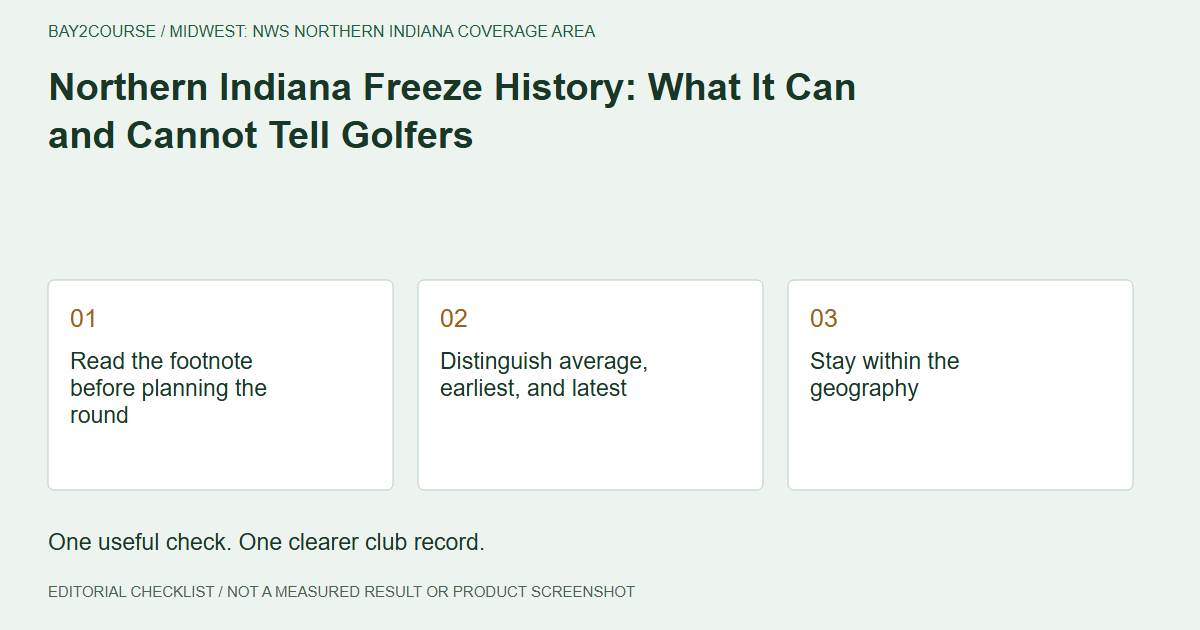
Read the footnote before planning the round
Northern Indiana first-freeze tables can help you think ahead, but their labels and footnotes matter. A historical average is not a predicted date for this autumn, and a station entry is not an opening schedule for your course.
The NWS Northern Indiana page identifies its displayed averages as calculations for 1991-2020 and cautions that they are not official NCEI climatological normals. That distinction is worth retaining when discussing the table. Do not upgrade an informal description into a more authoritative statistic than the source claims.
Distinguish average, earliest, and latest
The table presents different historical summaries. An average describes a set of past observations; an earliest or latest entry describes an extreme within the stated record. None tells you that the next season will follow the same sequence.
Use the information as a reminder to make an adaptable plan, not as a countdown to a guaranteed freeze. The page also states that its tables were updated in 2024. Reading them during 2026 does not transform their historical content into a current forecast.
Stay within the geography
The source serves a defined area that includes northern Indiana and neighboring locations. Do not select one station and apply its date to all of Michigan, Ohio, or the Midwest. A regional article can provide a useful planning method without pretending every reader shares the same local conditions.
For your actual destination, check current local weather information and the operator's instructions. The historical table and today's access decision are different evidence. Keeping them separate is the same habit you need when comparing simulator records with course observations.
Create two practical paths
If play is available and the round provides a suitable opportunity, observe one unresolved club question. If the course is unavailable or the observation opportunity is poor, use the time to inspect the original simulator report or clarify a coach note.
Neither path needs a fabricated result. 'Outdoor check still pending' fits within a 50-character note. Keep the scheduling details in your personal calendar or worksheet, and reserve the club card for the relevant golf evidence and its most important qualification.
Set the next decision point
After reviewing the historical context, choose when you will next check current conditions. This avoids making every practice decision from the same old table. It also gives you a clear point at which to confirm the course's schedule rather than assuming it remains unchanged.
At the end of the process, you should know what you will do if access is available and what useful task remains if it is not. That is a defensible use of freeze history. Predicting a precise course closure or outdoor club adjustment from it is not.
A worked example
DEMO - reading historical information without turning it into a forecast.
| Information | Useful role | Not established |
|---|---|---|
| Historical average | Seasonal planning context | 2026 freeze date |
| Historical extreme | Past variation | Expected course condition |
| Operator notice | Current access instruction | Universal regional schedule |
Common questions
Why not just use the average first-freeze date?
You can use it as historical planning context, with the source's stated limitations. It cannot establish this year's first freeze, conditions on a specific course, or whether your intended tee time will proceed.
Does a historical extreme describe what I should expect?
No. An extreme records an event within the source's observation period. It helps show variation, but it is not a forecast or a substitute for current local information.
Sources and further reading
Primary references behind this guide. Local course instructions and current weather take priority over seasonal averages.
Written by Bay2Course, the maker of the app. This is practical record-keeping guidance, not independent equipment testing or a claim of professional coaching credentials. How we prepare and correct guides.
Explore: trust · how it works