Midwest: northern Indiana, southwest Michigan, northwest Ohio
A Midwest First-Freeze Plan for Checking Three Clubs
First-freeze history can inform a flexible plan, but it cannot tell you when a course will open. Confirm local conditions and keep unchecked clubs marked pending.
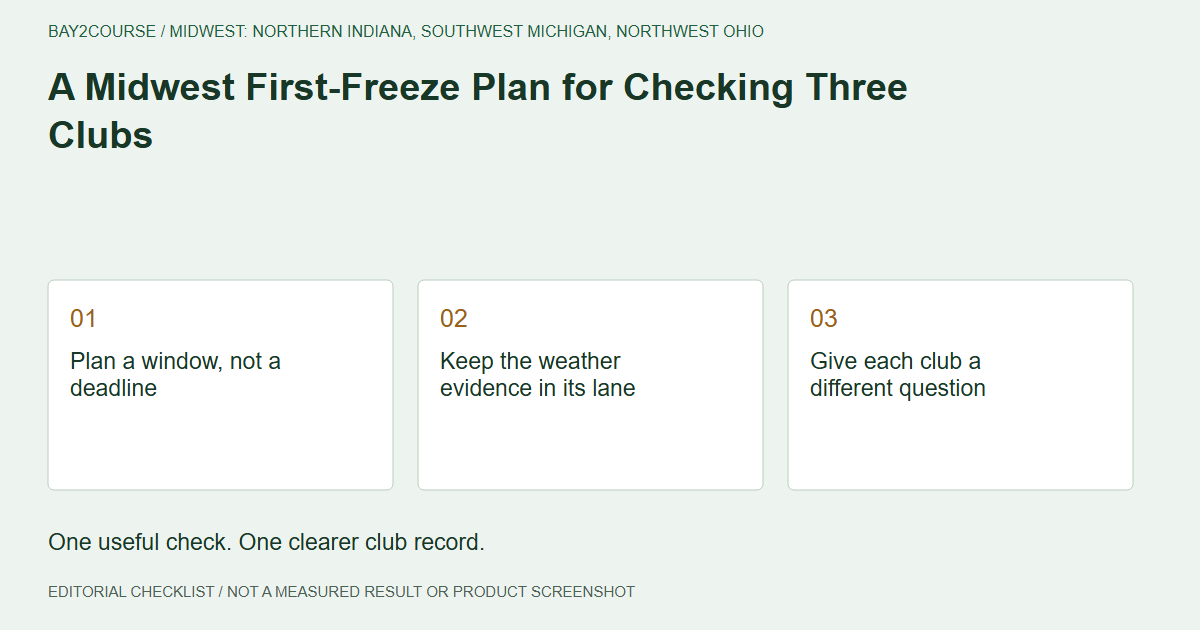
Plan a window, not a deadline
For golfers in northern Indiana, southwest Michigan, and northwest Ohio, historical first-freeze information can help prompt an autumn review. It cannot tell you which morning a particular course will open, delay play, or offer a suitable opportunity to check a club.
Build a flexible plan around three clubs you actually use. The purpose is to make the next available round informative, not to finish a bag-wide assignment before an assumed regional shutdown. Current local information should determine whether the outdoor part of the plan goes ahead.
Keep the weather evidence in its lane
The National Weather Service Northern Indiana page presents historical first-freeze information for locations in its coverage area. Treat those observations as seasonal context rather than a forecast for 2026. A station's historical date does not establish conditions on your intended fairway.
Before leaving home, check the local forecast and the course operator's latest instructions. If the operator has not confirmed an opening, do not treat a favorable forecast as permission to use the course. Make the weather check and the access check separate decisions.
Give each club a different question
Choose three clubs with distinct unresolved issues. Perhaps one card lacks a clear first-landing observation, another has an uncertain source label, and the third contains a coach question you have not revisited. These are more useful priorities than simply selecting your three longest clubs.
Decide which questions require outdoor play. A missing simulator label is usually a source-clarification task, not a reason to hit extra balls on the course. Assigning the right task to each club keeps a limited practice window from becoming an unfocused testing session.
Use ordinary play as the opportunity
During the round, observe relevant shots when they naturally arise. Do not force a particular club into an unsuitable situation to satisfy the plan. If the intended club is unused, record that the question remains open rather than borrowing evidence from a different club.
Keep notes brief enough for the 50-character limit. 'Landing seen; review target reference' identifies a useful follow-up. 'No suitable shot; check deferred' explains a missed opportunity. Save any longer account separately rather than compressing away the uncertainty that matters most.
Close each task honestly
Afterward, sort the three questions into answered, partly answered, and deferred in your own review worksheet. These are working descriptions, not claims about automatic product badges. A partly answered question can still improve your understanding without establishing a dependable outdoor yardage.
If access changes, move the source-clarification work indoors and reschedule only the outdoor questions. Revisit the plan after checking current conditions again. You have a useful autumn routine when every card has a sensible next action, even if the weather prevents completing all three checks.
A worked example
DEMO - fictional three-club planning worksheet, not app status badges.
| Club | Question | Next task |
|---|---|---|
| 7-iron | Was first landing visible? | Observe during suitable play |
| Hybrid | Which source metric was copied? | Clarify original report |
| Wedge | What did the coach want reviewed? | Revisit lesson record |
Common questions
Should I finish all three checks in the same round?
Only if ordinary play provides suitable opportunities. There is no need to manufacture shots or rush. An honestly deferred check is preferable to an entry made under unsuitable conditions just to complete the list.
Can I use this plan elsewhere in the Midwest?
The planning method is reusable, but the cited weather page has a defined regional scope. Use current local weather information and the relevant course operator's instructions for a different destination.
Sources and further reading
Primary references behind this guide. Local course instructions and current weather take priority over seasonal averages.
Written by Bay2Course, the maker of the app. This is practical record-keeping guidance, not independent equipment testing or a claim of professional coaching credentials. How we prepare and correct guides.
Explore: how it works · trust