Midwest: Great Lakes
Moving Great Lakes Practice Indoors Without Losing Course Context
When local conditions move practice indoors, bring the last course observation and its unanswered question. A new simulator session adds context; it does not erase outdoor evidence.
Use this in the app: import the session, keep the clubs in Bag DNA, and compare one shot in Course Mode.
Related Golf Notes: A Midwest First-Freeze Plan for Checking Three Clubs · When a Frost Delay Changes Your Midwest Practice Plan · Northern Indiana Freeze History: What It Can and Cannot Tell Golfers
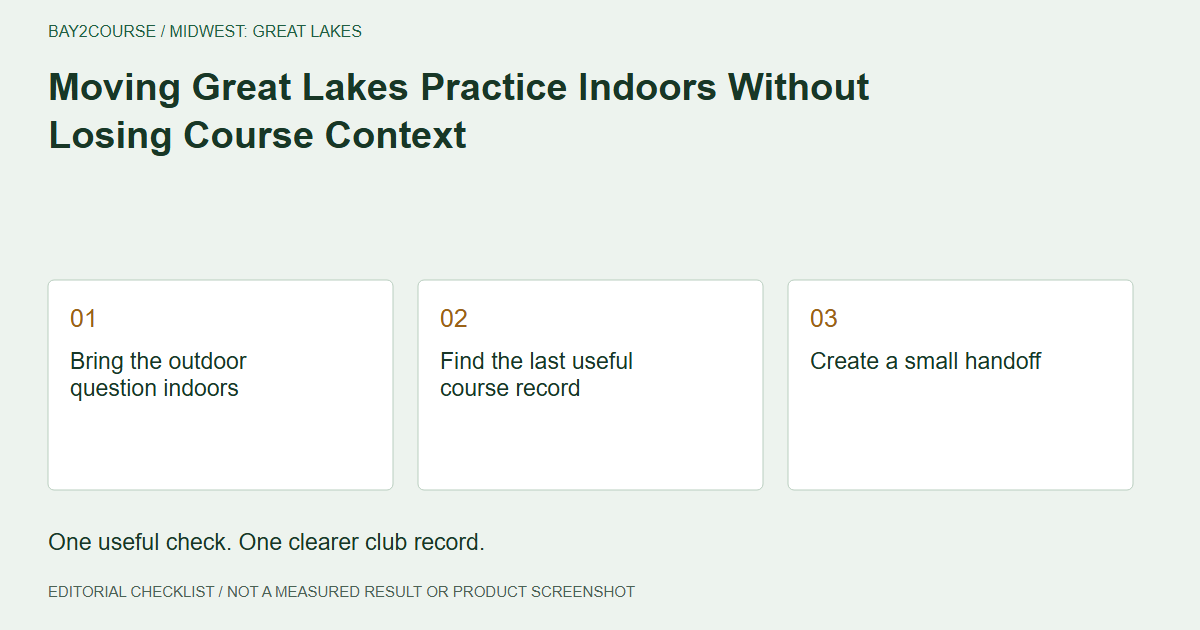
Bring the outdoor question indoors
When a Great Lakes golfer chooses to move practice indoors for autumn, the last course question should come along. Start the first indoor visit by reviewing the relevant card, not by treating the simulator session as a complete reset of everything observed outside.
The USGA notes frost delays among fall golf's seasonal issues, but there is no universal Great Lakes closing date established here. Your practice choice should follow your schedule, current local conditions, and the course's actual availability rather than an assumed regional cutoff.
Find the last useful course record
Choose one observation that still raises a meaningful question. Perhaps you saw the ball finish short but could not see the landing, or a coach wanted you to revisit the source behind an iron's baseline. Identify what is known before choosing the indoor task.
Do not turn a vague seasonal memory into a definite record. If you cannot recover the details of the last round, say that the context is incomplete. A new indoor session can provide new information without rewriting the uncertain past.
Create a small handoff
In your personal session plan, keep the last course date, the unresolved question, and the observation you hope to make indoors. The indoor objective should be something the source can actually establish, such as a clearly labeled carry entry, not a promise to reproduce an outdoor outcome.
The 50-character note 'Indoor follow-up; outdoor question open' preserves the distinction on the card. Keep the longer handoff separately. A compact reminder works best when it points to one decision rather than attempting to summarize an entire season.
Document the new indoor source
Before recording a new baseline, establish the metric, units, mode, and known settings. Trackman's historical normalization explainer illustrates the importance of modeled source context, but it does not prove which settings are active at your current venue.
Keep the new simulator session distinguishable from the earlier course observation. Do not average unlike evidence into one unexplained number. If the new record answers a source question but leaves the outdoor question unresolved, describe that partial progress accurately.
Decide what should return outdoors
After the indoor visit, choose whether another course observation would be useful and feasible. Check the destination forecast and operator schedule before planning it. If access is unavailable, preserve the question rather than labeling the indoor result as outdoor validation.
Share the handoff with your coach when it would help select the next task. The point of continuity is not to make every entry agree. It is to retain enough context that each new observation has a clear relationship to the question you were already trying to answer.
A worked example
DEMO - fictional course-to-indoor handoff.
| Part | Example |
|---|---|
| Outdoor question | First landing was not seen |
| Indoor task | Confirm a source-labeled carry entry |
| Short note | Indoor follow-up; outdoor question open |
| Later decision | Check local course availability |
Common questions
Should I replace my fall course notes with the new indoor results?
No automatic replacement is justified. They describe different observations. Retain useful course context and label the new simulator evidence so you can understand what each record contributes.
Does indoor practice mean the course-check project must stop?
Not necessarily. It may pause or alternate with available outdoor opportunities. Use local information to decide when a suitable check is possible, and keep any unfinished outdoor question explicit.
Sources and further reading
Primary references behind this guide. Local course instructions and current weather take priority over seasonal averages.
- www.usga.org/content/usga/home page/articles/2018/10/fall golf 5 things every golfer should know.html
- www.trackman.com/blog/normalization feature explained
Written by Bay2Course, the maker of the app. This is practical record-keeping guidance, not independent equipment testing or a claim of professional coaching credentials. How we prepare and correct guides.
Explore: how it works · for venues