National
Why Two Simulator Sessions Need Separate Source Notes
Two session numbers are not automatically comparable. Record each source and its known settings separately, then ask which differences are documented and which remain unknown.
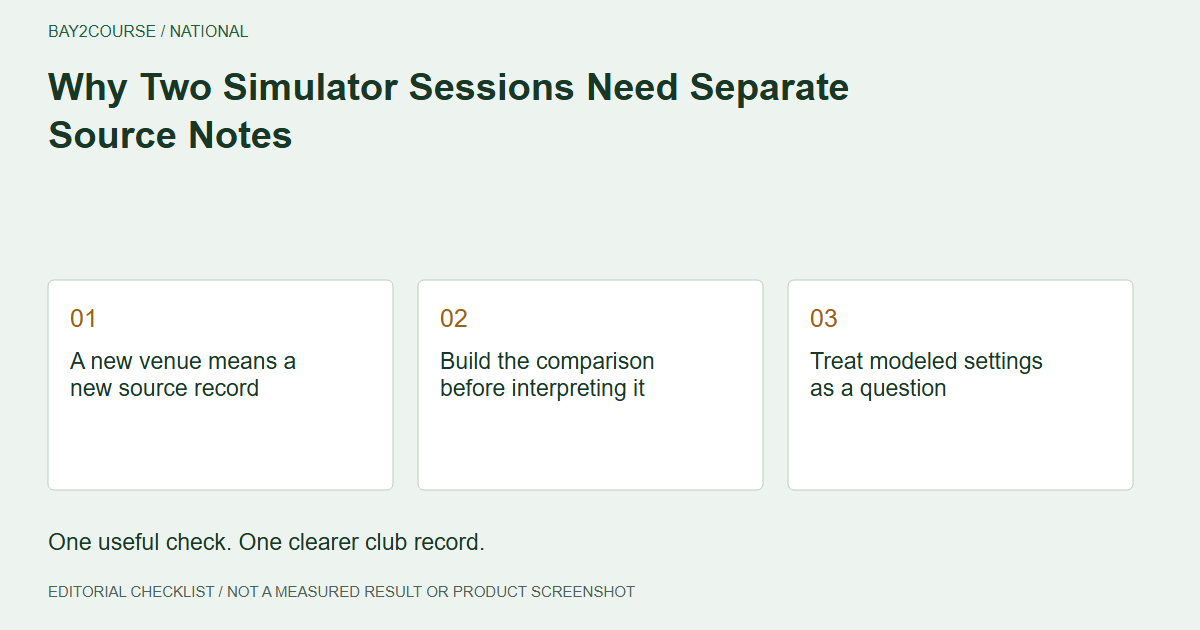
A new venue means a new source record
Two simulator visits can produce different numbers without establishing a change in your golf. Before replacing a club-card baseline, compare the records behind the values. A result from a second facility should retain its own identity, even when the club and the displayed distance label look familiar.
For an autumn golfer moving between available indoor venues, this is a practical bookkeeping problem. You do not need to decide which facility is better. You need to know whether the two entries answer the same measurement question.
Build the comparison before interpreting it
In a personal worksheet, place the session dates side by side. Add the club, exact metric label, units, ball if known, mode, and any confirmed settings. Leave blanks explicitly marked unknown rather than allowing an empty cell to imply that conditions matched.
The worksheet is a review aid, not an additional Bay2Course feature. Use the card's 50-character note for the key caveat, such as 'Second venue; settings not confirmed'. Keep the larger comparison separately so you can consult it when deciding what the new entry supports.
Treat modeled settings as a question
Trackman's historical normalization explanation illustrates why source context can matter: reported results may use modeled conditions. It does not establish the behavior of every current system or prove that either venue used normalization during your visit.
Ask about the actual sessions. If one venue can confirm its settings and the other cannot, retain that asymmetry. Do not fill the gap using an internet default or assume that identical vendor branding makes the sessions equivalent.
Work through one unresolved mismatch
Imagine two fictional entries for the same iron. Both say carry and use yards, but only the first has a confirmed mode. The second number may be worth keeping; it does not yet justify a confident comparison because one relevant part of its context remains unresolved.
Your next action is to clarify the missing mode, not to average the values or select whichever you prefer. If the information cannot be recovered, preserve the second visit as a separately qualified record and plan a better-documented session next time.
Decide what belongs on the card now
Before making a change, ask whether the existing baseline was mislabeled, whether genuinely comparable information is available, or whether you simply have another observation. Those are different reasons to edit. Keep a personal explanation of any correction without assuming automatic history is available.
Share both source contexts when asking a coach to review a difference. The goal is a useful next question, not a verdict that a venue is inaccurate or that your outdoor yardage has changed. Revisit the card when the evidence becomes clearer.
A worked example
DEMO - fictional cross-venue comparison worksheet.
| Detail | Visit A | Visit B |
|---|---|---|
| Metric | Carry | Carry |
| Units | Yards | Yards |
| Mode | Confirmed practice | Unknown |
| Decision | Keep context | Clarify before comparing |
Common questions
Is the most recent session automatically the best baseline?
No. Recency does not repair missing labels or unknown settings. Review what the entry actually represents before replacing a clearer source record simply because the new visit happened later.
Can I compare sessions from the same simulator brand?
Possibly, but the brand alone does not establish comparability. Check the actual metric, units, mode, and known settings. Keep unresolved differences visible instead of assuming the setup was identical.
Sources and further reading
Primary references behind this guide. Local course instructions and current weather take priority over seasonal averages.
Written by Bay2Course, the maker of the app. This is practical record-keeping guidance, not independent equipment testing or a claim of professional coaching credentials. How we prepare and correct guides.
Explore: trust · for venues