National
Create a Fall Club Card Before Your Next Simulator Session
A useful fall card separates simulator carry, coach notes, and course checks. Record where each number came from before treating it as a playing reference.
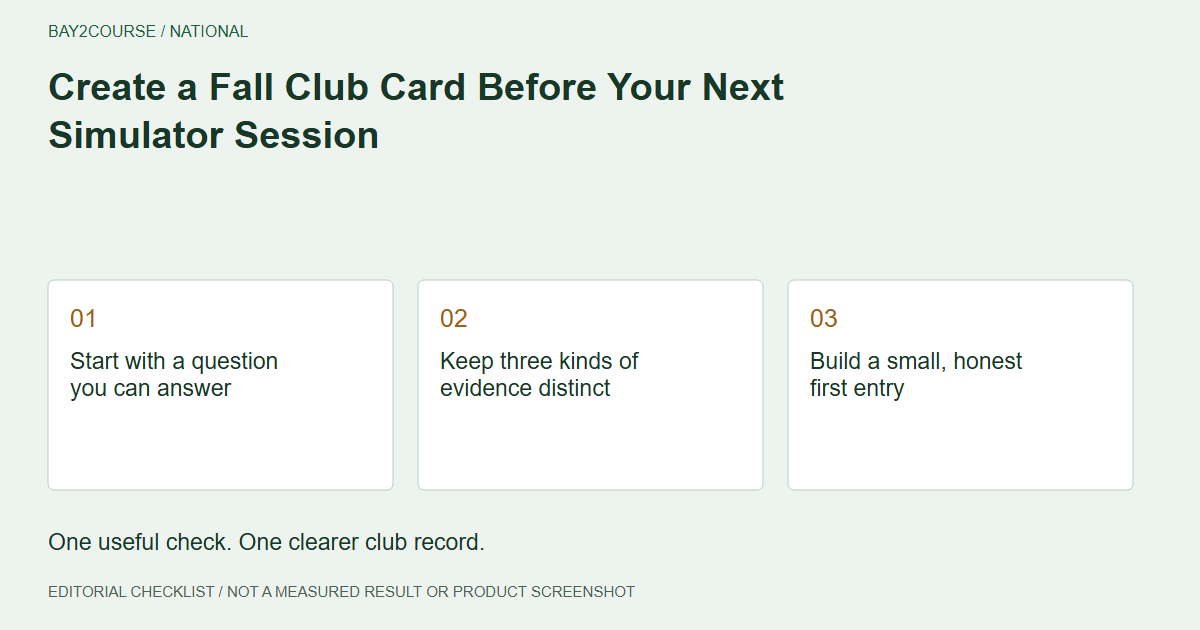
Start with a question you can answer
A fall club card is most useful when it begins with one club and one question. Before your next simulator visit, choose a club you regularly use for approaches. Your first task is to identify the carry information you already have, not to create a complete outdoor yardage chart in one sitting.
Autumn can put indoor sessions and course rounds close together on your calendar. That makes it especially important to distinguish where an entry came from. A number copied from a simulator and an observation made on a fairway answer different questions.
Keep three kinds of evidence distinct
Use simulator carry as a recorded baseline, coach notes as attributed guidance, and course checks as observations from actual play. Do not blend these into a single claim of accuracy. Trackman's carry explainer describes a particular equal-height convention; your source's exact label still matters.
Bay2Course brings these kinds of information into club cards. It does not turn an indoor number into an automatically correct outdoor distance. Keep any longer explanation in your own session record rather than expecting a short card note to hold an entire report.
Build a small, honest first entry
For a fictional example, suppose a report identifies a 7-iron carry of 145 yards. Confirm that the column really says carry and that the units are yards. Retain the report's date and source in your supporting record. The example value is not a recommended distance for your club.
A concise note such as 'Indoor carry; settings unknown' fits the 50-character limit and preserves an important qualification. If you cannot establish which settings were active, leave that question open. Missing information is not a reason to supply a plausible guess.
Choose the first outdoor question
Before a course round, decide what observation would be useful. You might want to know whether you can clearly see the first landing of a normal approach with that club. Do not plan to manufacture extra shots during busy play just to fill the card.
If the club never comes out of the bag, the outdoor question remains unanswered. If you see only where the ball finishes, describe that limitation. 'First landing not seen' is more useful than a precise-looking carry number unsupported by your observation.
Leave with a usable next step
Before ending the simulator session, check the club, distance label, units, and source. Then identify the single missing detail you will clarify next. Creating a trusted reference is a sequence of small decisions, not a one-time declaration that the entire bag is verified.
Revisit the card after an actual course opportunity or a conversation with your coach. Share the relevant entry with its qualification intact. Keeping the question visible helps the next reader understand both what you recorded and what you have not established.
A worked example
DEMO - fictional first-card evidence, not a product screenshot.
| Item | Example |
|---|---|
| Club | 7-iron |
| Reported carry | 145 yards |
| Short note | Indoor carry; settings unknown |
| Outdoor check | Pending |
Common questions
Do I need a number for every club before starting?
No. Start with a club whose source information you can understand. A small, clearly labeled reference is easier to review than a complete-looking bag chart assembled from mismatched or unknown measurements.
Can a course check prove the simulator number is correct?
It can add useful evidence about that occasion. It cannot guarantee every future shot. Preserve the observation's limitations and avoid treating one apparent agreement as a universal outdoor distance.
Sources and further reading
Primary references behind this guide. Local course instructions and current weather take priority over seasonal averages.
Written by Bay2Course, the maker of the app. This is practical record-keeping guidance, not independent equipment testing or a claim of professional coaching credentials. How we prepare and correct guides.
Explore: how it works · trust