National
Normalized Simulator Distance Is Not Tomorrow's Outdoor Yardage
Normalization describes a modeled set of conditions. Preserve that label and the documented settings; do not translate a normalized number into a guaranteed outdoor distance.
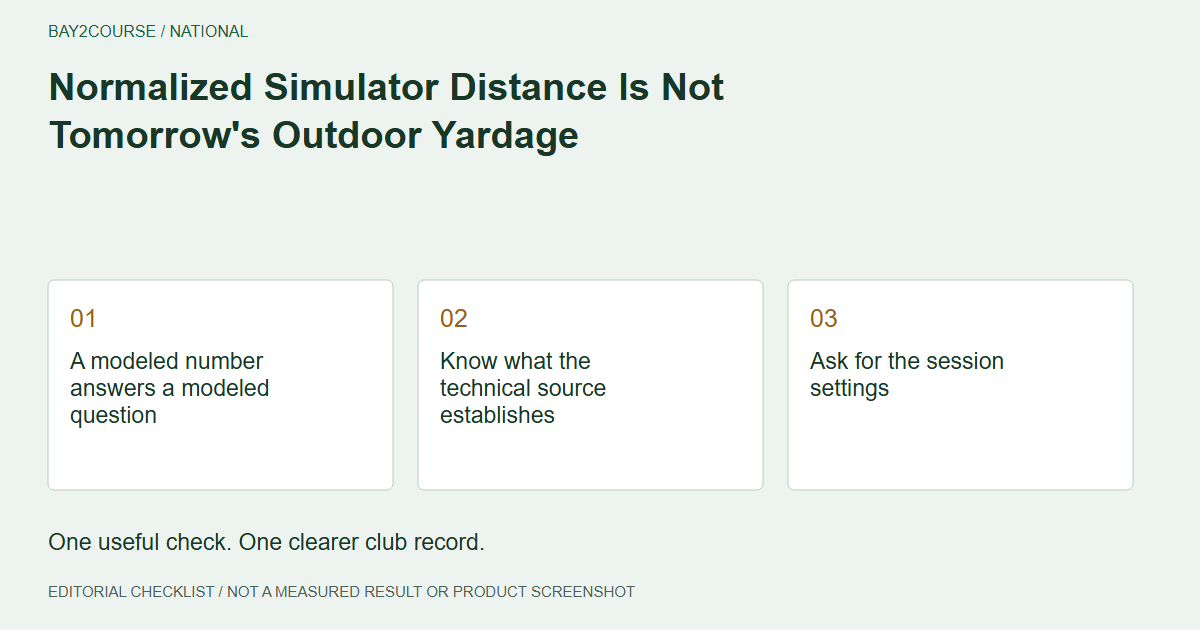
A modeled number answers a modeled question
A normalized simulator result is not a forecast for tomorrow's round. It describes a shot under the source's modeled assumptions. Preserve that context when you create a club card, especially when an autumn course observation seems different from the indoor number.
The useful question is not whether normalization is inherently good or bad. It is whether you know what the displayed value represents. A well-labeled modeled baseline can be useful without being a promise about a particular outdoor landing.
Know what the technical source establishes
Trackman's historical normalization explainer describes standardized conditions that include user-specified temperature and altitude and a calm-condition model. That is evidence about a vendor's normalization concept, not evidence that Bay2Course performs the same calculation or receives a verified integration feed.
The explainer dates from 2014. Do not assume its old defaults, screen layouts, or software behavior describe your current session. Ask about the setup actually used. The source helps frame the question; it does not replace checking the report in front of you.
Ask for the session settings
Before leaving the venue, ask whether the displayed distances were normalized and which relevant settings were recorded. If staff cannot establish that from the session, note the uncertainty. Do not copy settings from an online example merely because the same vendor name appears.
Your card note has 50 characters, so prioritize the key distinction. 'Normalized; settings not confirmed' is enough to warn a future reader. Keep a longer settings record separately if you have one, and do not imply the short note contains the entire configuration.
Give the course observation its own identity
Suppose a fictional indoor record is labeled normalized and a later course check says the ball finished short of a target. Those statements are not a matched pair of carry measurements. You may not have seen the landing, and the target reference may describe something else.
Record the observation honestly before drawing a conclusion. A useful short note could be 'Finished short; landing unseen'. That preserves what happened without converting the simulator baseline into an outdoor estimate or attributing the result to a single environmental factor.
Choose clarification over a correction rule
On the next visit, resolve the most consequential unknown first. That might mean confirming the metric label or asking whether normalization was active. Once that context is clearer, discuss with your coach which outdoor observation would help answer the remaining question.
Do not subtract one course result from one indoor result and apply the difference to every club. Bay2Course supports recording and revisiting evidence, not certifying a universal adjustment. Share both records with their source labels so a reviewer can see why they may differ.
A worked example
DEMO - two fictional records that answer different questions.
| Record | Short note | What remains open |
|---|---|---|
| Simulator | Normalized; settings not confirmed | Actual source settings |
| Course | Finished short; landing unseen | First landing position |
Common questions
Does normalized mean the distance was measured outdoors?
No. Normalization refers to how the source presents a modeled result. Check the report and provider documentation to understand the actual session and avoid treating the word as proof of outdoor validation.
Can I still use a normalized number as my starting baseline?
Yes, when it is clearly identified. Keep the source context and missing settings visible, then add qualified course observations instead of relabeling the modeled number as a guaranteed outdoor distance.
Sources and further reading
Primary references behind this guide. Local course instructions and current weather take priority over seasonal averages.
Written by Bay2Course, the maker of the app. This is practical record-keeping guidance, not independent equipment testing or a claim of professional coaching credentials. How we prepare and correct guides.
Explore: trust · how it works