Southwest: Phoenix Thanksgiving visitors
Thanksgiving Golf in Phoenix: Plan from Normals, Check the Forecast
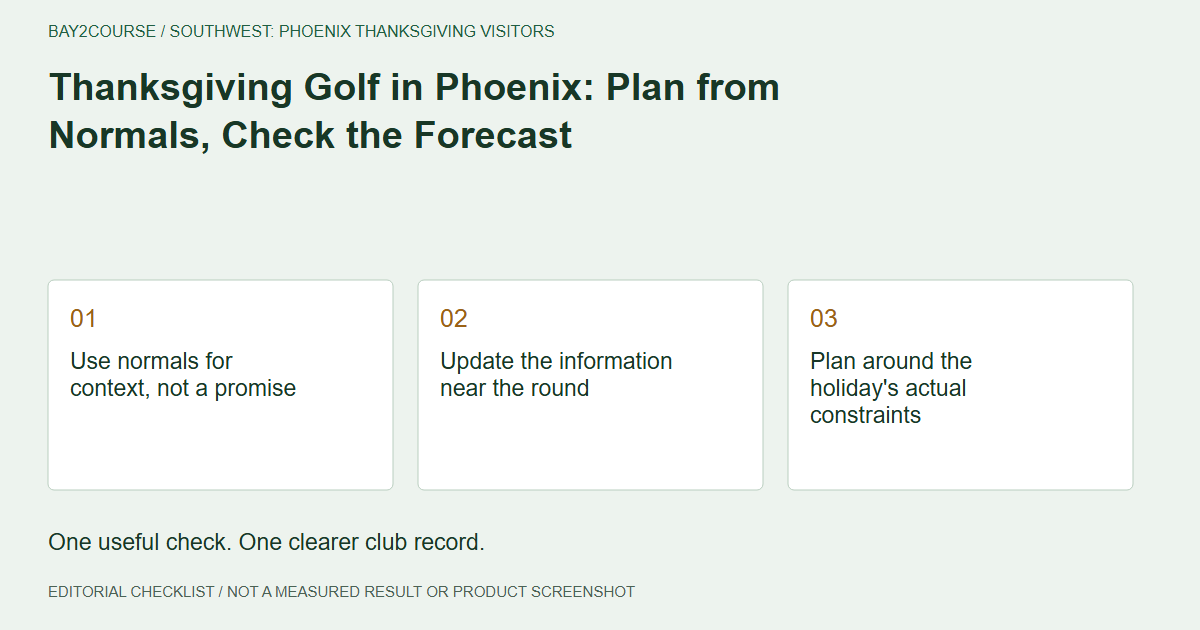
Phoenix holiday climate normals help frame planning, but they do not predict Thanksgiving 2026. Check the current forecast and course notices, then decide what observations your round can reasonably support.
Use this in the app: import the session, keep the clubs in Bag DNA, and compare one shot in Course Mode.
Related Golf Notes: Your First Arizona Winter Round: Start with a Carry Baseline · Overseeded Fairways: Keep Carry and Roll in Separate Notes · Cool Starts, Warmer Finishes: Logging a Phoenix November Round
Use normals for context, not a promise
For Phoenix Thanksgiving planning, NWS lists 1991-2020 normal highs of 71-73 F and normal lows of 49-51 F. Those are historical holiday reference ranges, not the forecast for Thanksgiving 2026. They can help frame the kind of information to check before a trip, but they cannot guarantee your tee-time conditions. Do not turn a climate table into a booking promise or use it to calculate a precise change to every club's carry.
Update the information near the round
As the visit approaches, check a current forecast for the course area and confirm the course's own operating information. Keep those checks separate: weather information does not establish access, and a tee-time confirmation does not describe the weather. Ask about practice availability if you intend to use it. Recheck relevant notices before leaving for the course. The historical normals remain background context even when the current forecast differs; they were never a prediction that the forecast must match.
Plan around the holiday's actual constraints
A holiday round may share the day with travel, meals, and other commitments. Decide how much practice time is genuinely available rather than designing a full-bag test you cannot complete. Choose one existing club-card question that ordinary play might help answer. If there is no suitable opportunity, leave it pending. Do not force a particular club, add unauthorized shots, or delay others to make the round serve the worksheet. The holiday schedule should narrow the task, not lower the evidence standard.
Record the observation, not the expected weather
After a relevant shot, distinguish what you observed from what you expected after reading the climate table. Record the club, shot intention, landing visibility, and distance basis on a separate sheet when practical. A fictional card note such as 'Holiday round; landing estimate only' fits the 50-character limit. If you mention temperature in the longer record, identify its source. A forecast value or a historical normal should not appear as though it was measured at the shot.
Review without a temperature formula
After the round, compare the observation with the original question. If the evidence is incomplete, preserve the useful indoor reference and state what remains unknown. If it is informative, share the context with your coach before drawing broader conclusions. One holiday round does not isolate temperature from equipment, lie, shot intention, or observation quality. Revisit the card because of what you learned, not because Phoenix has crossed a calendar date or because the day felt warmer than home.
Common questions
Are those temperatures the expected high and low for my booked day?
They are historical Thanksgiving normals for a stated reference period. Use the current local forecast for planning near your actual date and time.
Should a warmer forecast change every number on my card?
No automatic card adjustment follows from this planning information. Keep weather context separate from measured or estimated carry observations and avoid fixed temperature-to-yardage rules.
Sources and further reading
Primary references behind this guide. Local course instructions and current weather take priority over seasonal averages.
Written by Bay2Course, the maker of the app. This is practical record-keeping guidance, not independent equipment testing or a claim of professional coaching credentials. How we prepare and correct guides.
Explore: how it works · trust