Southwest: desert courses with confirmed overseeding
Overseeded Fairways: Keep Carry and Roll in Separate Notes
Ask the course whether overseeding affects current access and playing conditions. Keep carry separate from roll so a different final resting distance does not automatically rewrite your simulator baseline.
Use this in the app: import the session, keep the clubs in Bag DNA, and compare one shot in Course Mode.
Related Golf Notes: Your First Arizona Winter Round: Start with a Carry Baseline · Create a Fall Club Card Before Your Next Simulator Session · Carry vs. Total: Which Number Belongs on Your Club Card?
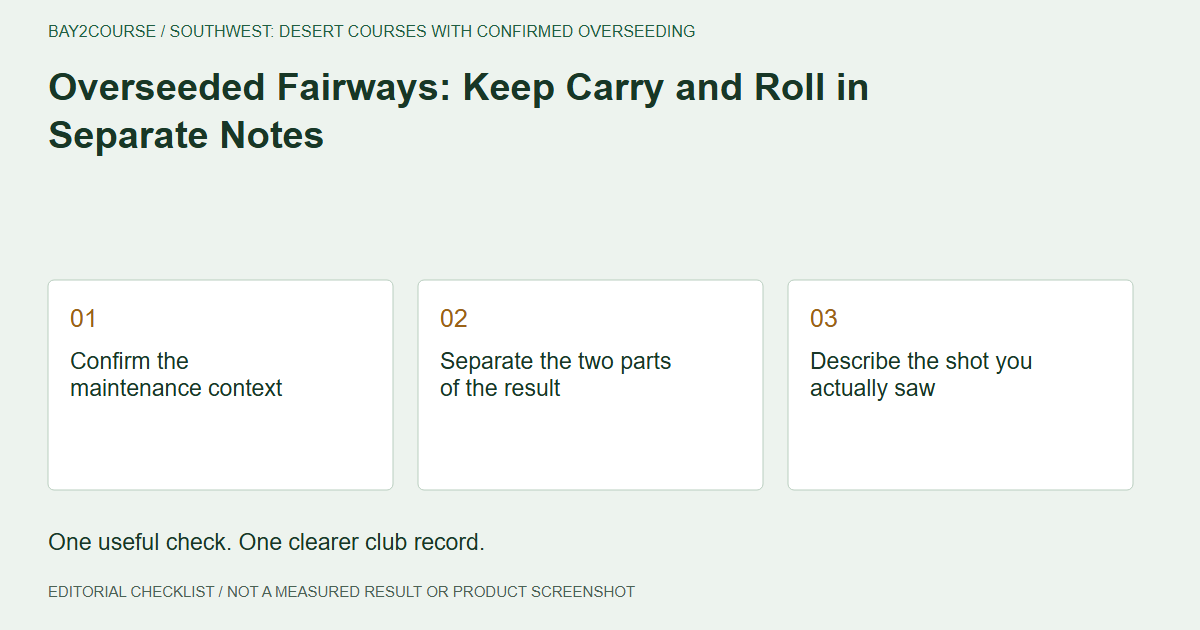
Confirm the maintenance context
When a desert course discusses overseeding, ask what that means for your visit rather than assuming a standard schedule. USGA winter guidance describes overseeding as one approach to maintaining winter playing surfaces, with costs and disruption. It does not provide a distance penalty for your clubs. Confirm the course's current access and conditions, then keep those facts separate from your carry reference. A maintenance label cannot tell you where a particular shot will land or finish.
Separate the two parts of the result
Carry concerns the distance to the landing; total distance concerns the final resting position. Those are different observations. In the fictional table below, the landing and resting positions are both supplied solely to illustrate that distinction. They are not measurements from a customer or an overseeded course. If only the resting position were known, the missing landing could not be reconstructed simply by guessing how much roll an overseeded fairway should produce.
Describe the shot you actually saw
For a useful course check, identify the club, ball, lie, and basis for the distance estimate. Note whether the landing was clearly visible and whether you observed what happened afterward. Keep slope and visible moisture in the separate context rather than attributing the result entirely to overseeding. You are not diagnosing turf or running an agronomy trial. You are deciding whether the observation is informative enough to sit beside an existing club record.
Keep the indoor reference intact
An indoor carry number does not become wrong merely because the ball finishes somewhere unexpected on a different surface. First check whether you are comparing carry with carry. A short Bay2Course note such as 'Landing seen; roll recorded separately' stays within the 50-character limit and preserves the key distinction. Save longer measurements and uncertainties on your own worksheet. If the landing was unclear, say so instead of replacing the baseline with the final resting distance.
Return with one question
At your next permitted opportunity, revisit the uncertainty that matters most. Perhaps you need a clearer landing observation, or perhaps the original simulator metric was never confirmed. Resolve that question before explaining a supposed course-wide yardage change. During ordinary play, do not hit extra test balls or enter restricted areas to complete a table. A well-described incomplete check can help a coach understand your concern without turning a maintenance practice into a universal distance rule.
A worked example
DEMO: Invented distances illustrate two different observations, not an overseeding effect.
| Observation | Illustrative distance | Meaning |
|---|---|---|
| Landing | 140 yards | Carry in this fictional example |
| Final rest | 147 yards | Total distance in this fictional example |
| Landing not observed | Unknown | Do not infer carry from final rest |
Common questions
Does overseeding always reduce roll?
Do not use overseeding alone to predict a particular result. Ask about current course conditions and record what you observe rather than assigning every shot a standard penalty.
Can I update carry from a ball's final position?
Not without adequate landing evidence. Keep the resting-distance observation separate and preserve the carry question until you have a more informative check.
Sources and further reading
Primary references behind this guide. Local course instructions and current weather take priority over seasonal averages.
Written by Bay2Course, the maker of the app. This is practical record-keeping guidance, not independent equipment testing or a claim of professional coaching credentials. How we prepare and correct guides.
Explore: how it works · trust