National
How to Label Range-Ball and Playing-Ball Sessions
Label the ball used and any known source conversion setting. If either is unknown, say so; Bay2Course should not be described as converting one ball's results into another's.
Use this in the app: import the session, keep the clubs in Bag DNA, and compare one shot in Course Mode.
Related Golf Notes: Create a Fall Club Card Before Your Next Simulator Session · Carry vs. Total: Which Number Belongs on Your Club Card? · Normalized Simulator Distance Is Not Tomorrow's Outdoor Yardage
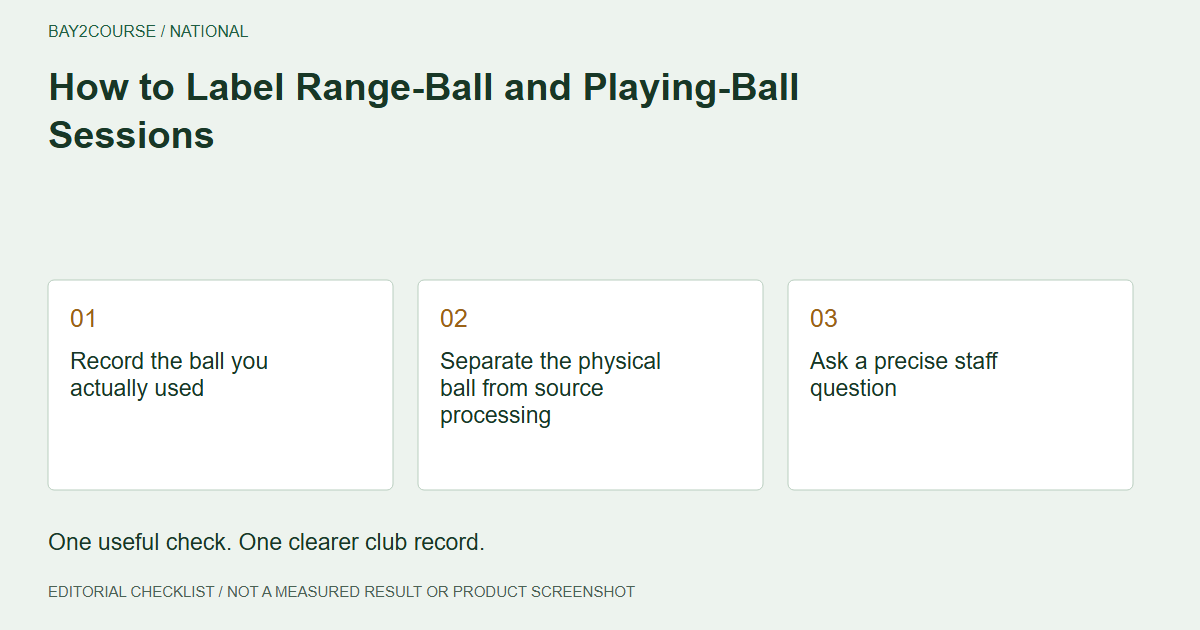
Record the ball you actually used
Before comparing a range session with a playing-ball session, establish what ball was involved in each. Use the identity you can confirm, not an assumption based on the facility or the appearance of the ball. If you do not know, label that part of the record unknown.
This matters when autumn practice moves among a course range, an indoor bay, and ordinary rounds. The same club may appear throughout, but a useful comparison needs more context than the club name and a distance number.
Separate the physical ball from source processing
There are two different questions: what ball was struck, and what processing the source applied to the displayed result. Knowing the first does not necessarily answer the second. Ask whether the displayed data includes any source-side conversion rather than assuming it represents an untouched measurement.
Trackman's historical normalization explainer discusses ball conversion in its own technical context. That supports asking about conversion; it does not establish how every current system works. It also does not mean Bay2Course converts range-ball results into playing-ball distances.
Ask a precise staff question
A useful question is whether the value on the report already includes source-side processing related to the ball. Point to the metric you intend to record. If staff can confirm the status for that session, preserve the answer in your personal source record.
If the status cannot be established, do not apply your own percentage adjustment to compensate. An unverified correction would add another assumption. The session may remain useful as a separately labeled record while the comparison question stays open.
Use a compact label that preserves uncertainty
A note such as 'Range ball; conversion unknown' fits within 50 characters and distinguishes two facts efficiently. Another session might use 'Own ball; source settings unconfirmed'. Keep any longer details, including how you obtained the information, outside the short card note.
Do not label two sessions equivalent merely because you believe the balls are similar. Nor should a missing brand name automatically make every other part of the record worthless. State the particular unknown so a reviewer can judge its relevance.
Revisit the comparison without inventing a formula
Place the two source records beside each other in a personal worksheet. Check their metric labels, units, and known settings before interpreting a difference. If the ball context is unresolved, make clarifying that context the next task rather than calculating a supposedly corrected outdoor yardage.
Share the entries with your coach when the question affects your practice plan. The useful outcome may be a better-documented next session. Keeping the records honest is more valuable than forcing unlike sources into a precise-looking single baseline.
A worked example
DEMO - fictional ball-context labels, not conversion recommendations.
| Session | Short note | Open question |
|---|---|---|
| Range | Range ball; conversion unknown | Was conversion applied? |
| Indoor | Own ball; source settings unconfirmed | Which settings were active? |
Common questions
Can I use a standard range-ball conversion percentage?
No universal percentage is established by these sources for your session. Check the provider's actual processing and retain unknowns. An invented adjustment can make the record appear more certain without adding evidence.
Does using my own ball make every session directly comparable?
No. Ball identity is one part of the context. Metric labels, units, mode, and source settings still need review before you treat a difference as a change in your club's performance.
Sources and further reading
Primary references behind this guide. Local course instructions and current weather take priority over seasonal averages.
Written by Bay2Course, the maker of the app. This is practical record-keeping guidance, not independent equipment testing or a claim of professional coaching credentials. How we prepare and correct guides.
Explore: trust · for venues