Midwest and Northeast
Cold Morning, Mild Afternoon: Keep Two Observations, Not One Rule
Two checks at different times can be useful records without proving temperature caused a difference. Keep their actual context separate and avoid an automatic yards-per-degree rule.
Use this in the app: import the session, keep the clubs in Bag DNA, and compare one shot in Course Mode.
Related Golf Notes: A Midwest First-Freeze Plan for Checking Three Clubs · When a Frost Delay Changes Your Midwest Practice Plan · Northern Indiana Freeze History: What It Can and Cannot Tell Golfers
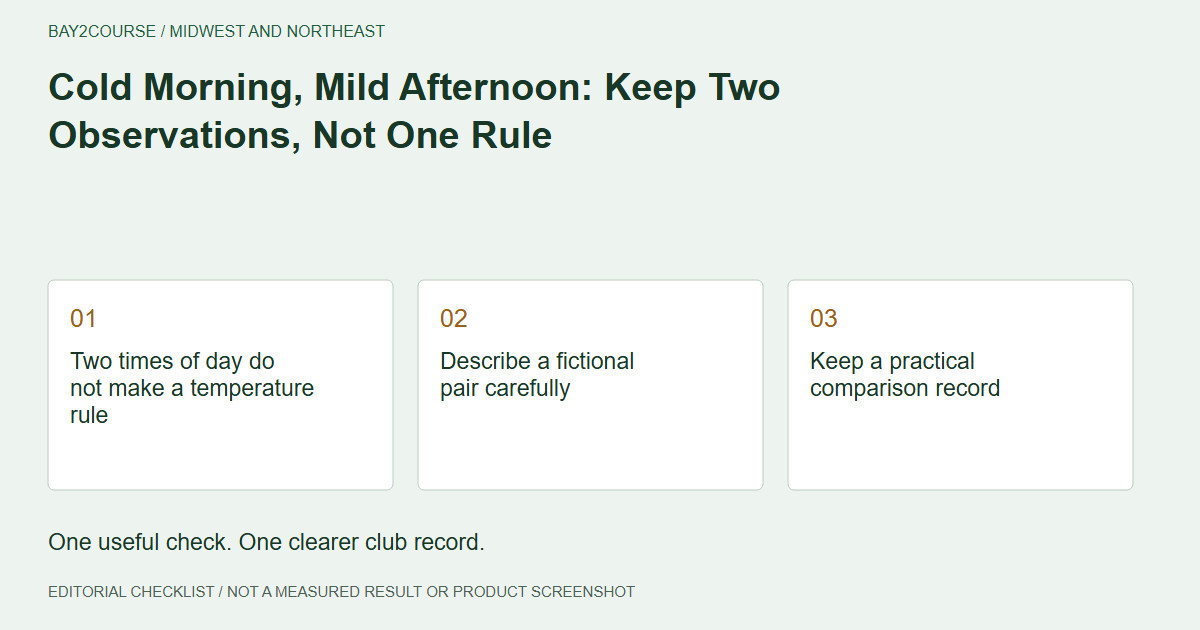
Two times of day do not make a temperature rule
A cold-morning and mild-afternoon comparison can produce useful observations without isolating the effect of temperature. Record the two occasions separately. Do not turn a pair of outcomes into a fixed yards-per-degree rule or a universal instruction to change clubs.
For Midwest and Northeast autumn golfers, this is a familiar planning scenario, not a forecast for a particular day. Confirm current local weather and course access before arranging either outing. The conditions you actually encounter belong in the record; the conditions you imagined do not.
Describe a fictional pair carefully
Imagine a fictional golfer using the same iron on two occasions in one day. The morning landing is obscured, while the afternoon landing is visible. Even before discussing weather, the evidence differs in a fundamental way: one observation contains information the other lacks.
If the afternoon result looks longer, you have not established why. The two entries may differ in target reference, lie, ball, source context, or what was observed. Naming possible differences is not a diagnosis; it is a reminder of the questions still open.
Keep a practical comparison record
In a personal worksheet, record time, club, source, ball if known, lie description, and landing visibility. Use observed or documented information, and mark uncertain details as uncertain. Do not retrospectively supply precise temperatures or settings you did not record.
Keep the card note within 50 characters. 'Morning: first landing unseen' and 'Afternoon: first landing visible' preserve the most important contrast in this example. Longer weather and session details can stay in the supporting record rather than overwhelming the short note.
Do not borrow a model as a personal formula
Trackman's normalization explanation discusses modeled conditions in a vendor-specific technical context. It does not supply evidence that two of your course shots can establish an exact correction. Nor does it mean Bay2Course automatically adjusts an indoor number to the afternoon forecast.
A mathematical difference between entries can describe the entries without explaining their cause. Avoid converting that difference into a prescription for every club. The appropriate next step depends on which part of the record is missing or incomparable.
Ask for the next useful observation
Share the pair with your coach and ask what would help interpret it. You might first need a clearer landing observation, a confirmed source label, or a better-understood target reference. A thoughtful next question is more useful than a confident seasonal adjustment built from weak evidence.
If another check is planned, use current local information and ordinary suitable opportunities. You do not need to reproduce a fictional morning or afternoon schedule exactly. Revisit the card when new evidence clarifies something, while preserving the limits of the original pair.
A worked example
DEMO - fictional same-day observations, not a weather forecast or correction model.
| Occasion | Short note | Evidence limit |
|---|---|---|
| Morning | Morning: first landing unseen | Landing unknown |
| Afternoon | Afternoon: first landing visible | One observed occasion |
| Conclusion | Further context needed | No temperature rule established |
Common questions
Does this mean weather cannot affect a golf shot?
No. It means this pair of observations does not isolate a cause or establish a precise personal correction. Keep the distinction between a general environmental concept and what your records actually prove.
Can I compare the two records at all?
Yes, as separate observations with stated context. Identify what is known, what differs, and what remains unknown. Avoid treating the comparison as a controlled test or a guaranteed rule for future shots.
Sources and further reading
Primary references behind this guide. Local course instructions and current weather take priority over seasonal averages.
Written by Bay2Course, the maker of the app. This is practical record-keeping guidance, not independent equipment testing or a claim of professional coaching credentials. How we prepare and correct guides.
Explore: for coaches · trust