National
Your First Course Check: Observe One Club, Not the Whole Bag
Start with one club and record what you could actually observe. An uncertain landing point stays uncertain; a single course check does not establish a universal yardage.
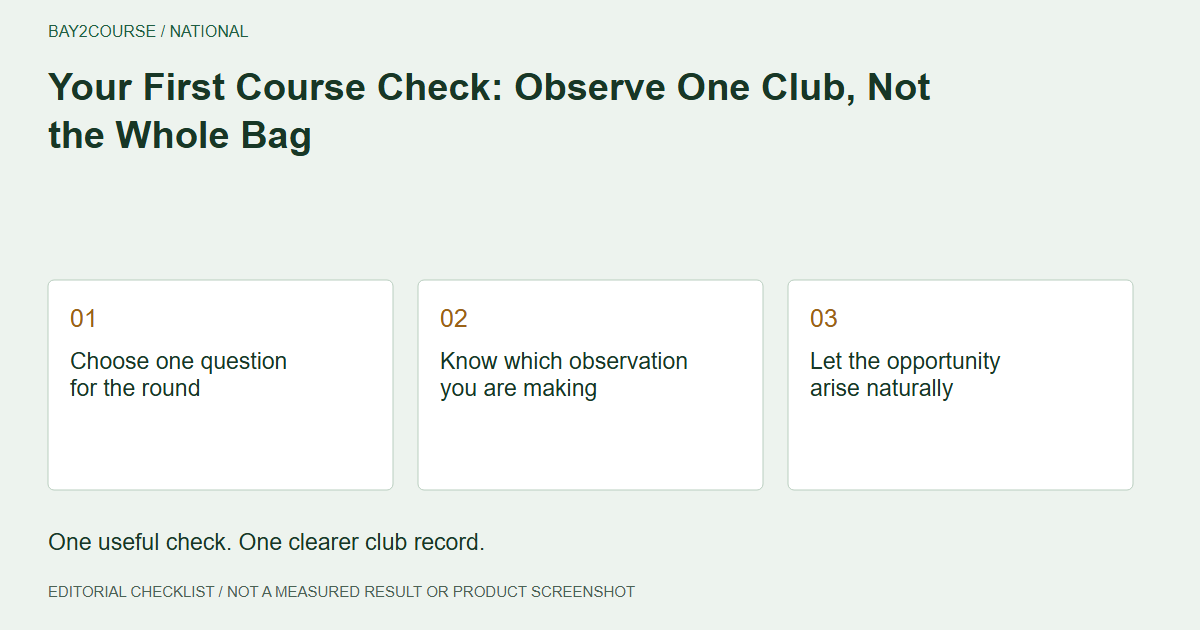
Choose one question for the round
Your first course check does not need to cover the whole bag. Pick a club whose simulator entry you understand and decide what you want to observe. A manageable question might be whether the first landing is visible on a normal approach.
This keeps the check separate from a search for a perfect shot. You are collecting context for a card, not conducting a controlled experiment during ordinary play. If the right opportunity never appears, you can finish the round without inventing a result.
Know which observation you are making
Trackman's carry definition uses a particular equal-height trajectory convention. A course observation may not provide that same measurement. Seeing the ball near a target afterward does not tell you exactly where it first landed or make the shot directly equivalent to a simulator result.
Describe what you can actually establish. Note the club, the shot's context, and whether the landing was visible. If a distance reference came from another source, retain that source in your personal record. Bay2Course should not be treated as a GPS measurement device.
Let the opportunity arise naturally
Use a shot that fits the round rather than choosing a club solely to satisfy the plan. Respect the course's instructions and the pace of play. A quiet moment after the hole is a better time for a note than interrupting everyone to reconstruct a flight.
Autumn outings can leave fewer suitable observation opportunities than you expected, but there is no requirement to make the card look complete. If the shot is obscured or the target reference unclear, preserve the limitation. 'Landing unseen; check again' is short enough for a 50-character note.
Separate the observation from the explanation
Suppose a fictional 7-iron approach finishes beyond the intended area. You can record the finish without deciding that your simulator baseline was wrong. The observation alone may not establish the landing point, the cause of the outcome, or a repeatable distance.
Keep your interpretation as a question: what would help distinguish landing distance from what happened afterward? A coach can review the context with you. Do not turn one result into a bag-wide subtraction rule or assume the card automatically diagnoses the discrepancy.
Choose a useful next check
After the round, reread the entry beside the simulator baseline. Identify what the course check added and what remains unknown. Sometimes the next step is another observation; sometimes it is clarification of the original metric or a more precise target reference.
Share only the relevant club and question when asking for help. A modest entry with an explicit limitation is more useful than a confident yardage assembled from incomplete evidence. Revisit the card when you have something new to add, not merely because another day has passed.
A worked example
DEMO - fictional first-check record.
| Item | Observation |
|---|---|
| Club | 7-iron |
| Opportunity | Normal approach during play |
| Short note | Landing unseen; check again |
| Next question | Can first landing be observed clearly? |
Common questions
Should I hit several extra balls to verify the number?
Do not turn ordinary play into an unscheduled testing session. Follow course instructions and use suitable opportunities. A dedicated practice setting may be more appropriate for a longer review arranged with your coach.
Can I record a check without an exact yardage?
Yes. A qualified observation can still be useful. State what you saw and what you could not establish rather than presenting an estimate as a measured carry distance.
Sources and further reading
Primary references behind this guide. Local course instructions and current weather take priority over seasonal averages.
Written by Bay2Course, the maker of the app. This is practical record-keeping guidance, not independent equipment testing or a claim of professional coaching credentials. How we prepare and correct guides.
Explore: how it works · trust