National with Midwest and Northeast fall examples
Your 30-Day Club-Card Review: Create, Revisit, Prove, Share
Review what you created, revisited, checked, and shared. A useful month ends with clearer evidence and a next question, not an unsupported claim that scores or distances improved.
Use this in the app: import the session, keep the clubs in Bag DNA, and compare one shot in Course Mode.
Related Golf Notes: Create a Fall Club Card Before Your Next Simulator Session · Carry vs. Total: Which Number Belongs on Your Club Card? · Normalized Simulator Distance Is Not Tomorrow's Outdoor Yardage
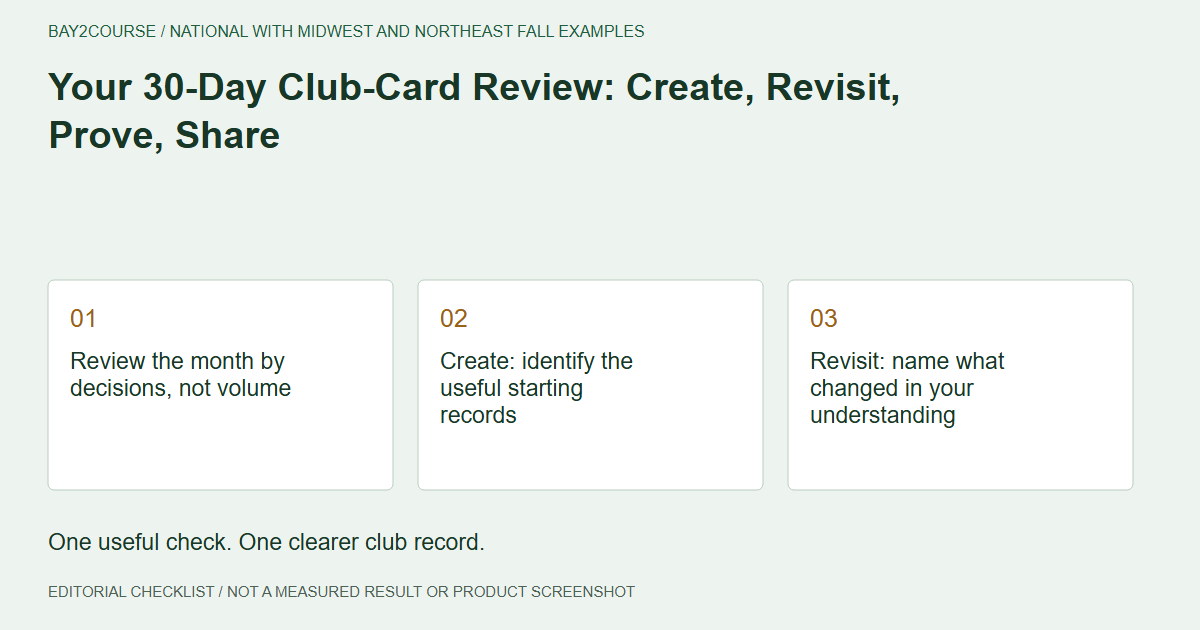
Review the month by decisions, not volume
A 30-day club-card review should show what became clearer and what still needs attention. The number of sessions, notes, or rounds is not the same as the quality of the evidence. Organize the review around four actions: create, revisit, prove, and share.
Use a personal worksheet for the longer reflection, leaving the card's 50-character note for the most important next question. The month can be useful even when some planned checks did not happen. Honest gaps belong in the review rather than being hidden by a finished-looking chart.
Create: identify the useful starting records
List the club cards you created and ask whether each has an understandable source. Confirm the metric and units rather than assuming a familiar distance label was copied correctly. A documented starting point is more useful than a complete bag assembled from uncertain numbers.
Trackman's carry explainer reminds us that a metric has a defined meaning. Keep the definition attached to its source and do not present a simulator entry as automatic outdoor truth. For this part of the review, the question is whether the starting record can be explained.
Revisit: name what changed in your understanding
Look for corrections and clarifications made during the month. Perhaps you recovered a missing report heading, identified a mode, or separated a coach instruction from your own interpretation. These are concrete changes in understanding even when the displayed distance stayed the same.
Consider a fictional month in which an iron card was corrected from a mislabeled entry while a hybrid's source settings remained unknown. Record both outcomes. Revisit does not require every question to be resolved; it requires an honest account of what is now known.
Prove: describe the observation you actually gained
Review course checks individually. A visible landing, an obscured landing, and an unused club should not receive the same conclusion. Here, prove means support a specific observation, not certify a universal yardage or promise that the next shot will match.
For a Midwest or Northeast golfer whose autumn plans were interrupted, deferred work remains deferred. Do not count an indoor fallback as an outdoor check. A concise reminder such as 'Next: clarify hybrid source label' can preserve the next task without filling the note with a month's scheduling history.
Share: choose one next-month question
Select the card whose unresolved question would benefit most from a coach's review or source clarification. Share the relevant context, not every record by default. Explain what you want to understand and retain the qualification that makes the entry honest.
End the month with one practical next action. Do not claim a score reduction, distance gain, or other improvement unless separate evidence supports that claim. The completed review should leave a usable reference and a clear next question, whether you continue outdoors, indoors, or between both settings.
A worked example
DEMO - fictional month-end review, not customer results.
| Action | Example outcome | Next decision |
|---|---|---|
| Create | Source-labeled iron card | Keep supporting report |
| Revisit | Metric label corrected | Review adjacent entry |
| Prove | One qualified course observation | Leave other checks open |
| Share | One coach question prepared | Choose next task |
Common questions
Does finishing the 30-day review mean my bag is verified?
No. The review summarizes the evidence and questions you actually have. Some cards may remain incomplete or uncertain. A completed review is not a certification of every club's outdoor performance.
What should I do first in the next month?
Choose one unresolved question that affects a card you use. Match it to the right task: source clarification, a coach conversation, or a suitable course observation. Avoid collecting more numbers without knowing why.
Sources and further reading
Primary references behind this guide. Local course instructions and current weather take priority over seasonal averages.
Written by Bay2Course, the maker of the app. This is practical record-keeping guidance, not independent equipment testing or a claim of professional coaching credentials. How we prepare and correct guides.
Explore: how it works · trust · pricing