National: golfers heading south
Wedge Gapping Before a Winter Golf Trip
Record full and intentional partial wedge shots separately. A useful travel reference names the shot being tested and the evidence behind it rather than assigning one universal distance to each wedge.
Use this in the app: import the session, keep the clubs in Bag DNA, and compare one shot in Course Mode.
Related Golf Notes: Create a Fall Club Card Before Your Next Simulator Session · Carry vs. Total: Which Number Belongs on Your Club Card? · Normalized Simulator Distance Is Not Tomorrow's Outdoor Yardage
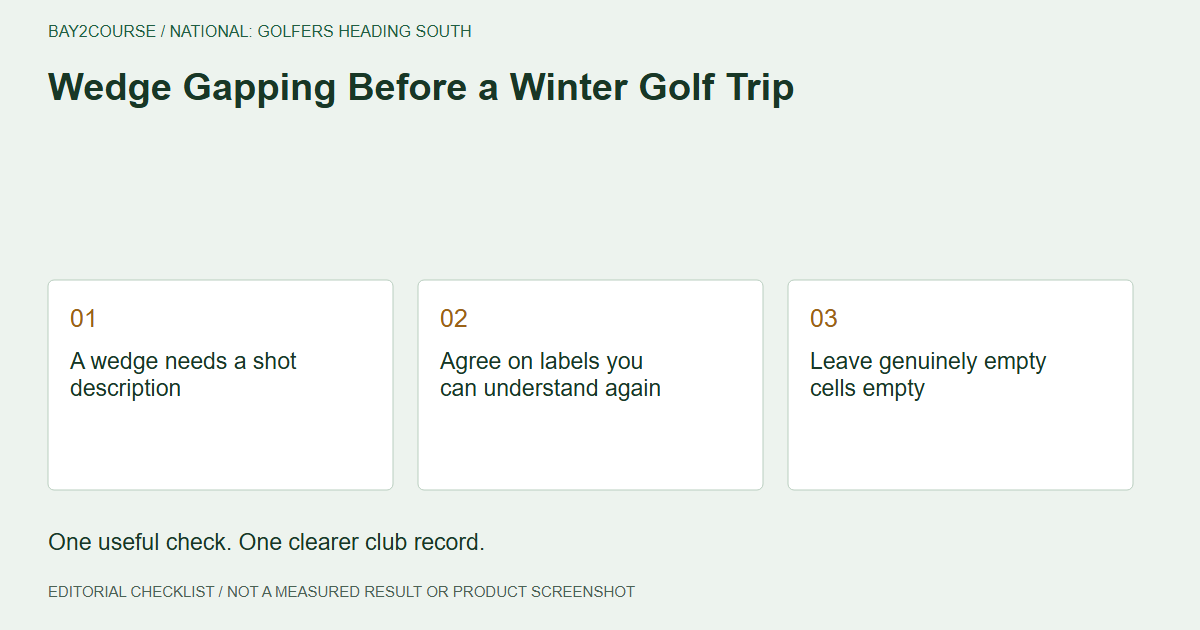
A wedge needs a shot description
Before a winter trip, separate full wedge shots from intentional partial shots in your records. One number beside a wedge can hide several different tasks. A useful reference says which shot you intended and where its carry evidence came from. It does not assume that every golfer's partial motion produces the same distance. If your current record mixes different intentions, the first job is to clarify the labels rather than create a more precise-looking average.
Agree on labels you can understand again
Choose descriptions that you and your coach can recognize at the next session. Comfortable partial may be useful if both of you understand what it means, but it is not a universal swing prescription. Write the longer explanation on a separate worksheet. Keep the club identity and ball consistent with the label, and record the session date. If you cannot describe which shot produced an older number, mark the entry uncertain instead of assigning it to the closest-looking category.
Leave genuinely empty cells empty
Arrange the worksheet by wedge and intended shot. A blank partial-shot entry is a question, not an invitation to calculate an answer from loft. The demonstration table uses no yardage because its purpose is to show how missing information should remain visible. If two entries appear to overlap, confirm that they describe comparable intentions before interpreting the result. A calculator may organize full-shot gaps, but it cannot prove an untested partial-shot carry or fill an evidence gap by itself.
Document a focused session
Select the most relevant missing or disputed entry rather than trying to complete the entire matrix at once. Confirm the displayed metric, units, and known simulator context. Record the observations on your worksheet and retain the awkward results as well as the clean ones. On the Bay2Course card, 'Partial wedge; label confirmed' is a fictional note within the 50-character limit. Keep the detailed definition elsewhere so the short note does not have to carry the whole explanation.
Take one question to the destination
At the winter destination, check practice access and choose a permitted opportunity to observe the intended shot. Identify the landing only when it is visible and you have a reasonable distance basis. A final resting point does not answer the carry question. Share the remaining uncertainty with your coach and revisit the same label afterward. A travel wedge reference is useful when it helps you recognize what you know, not when every cell contains a number regardless of its origin.
A worked example
DEMO: Fictional wedge worksheet showing why shot labels and missing entries matter.
| Club | Shot label | Evidence state |
|---|---|---|
| Wedge A | Full | Indoor reference recorded |
| Wedge A | Comfortable partial | Description needs clarification |
| Wedge B | Comfortable partial | Not yet checked |
Common questions
Should I use clock-face positions for every partial shot?
Only if that is a description you and your coach deliberately use. This recording method does not prescribe mechanics or promise that a position corresponds to a fixed distance.
Can the loft difference tell me the missing carry?
Not as evidence of your actual shot. Keep the missing entry open and gather a documented observation rather than presenting an inferred number as measured carry.
Sources and further reading
Primary references behind this guide. Local course instructions and current weather take priority over seasonal averages.
Written by Bay2Course, the maker of the app. This is practical record-keeping guidance, not independent equipment testing or a claim of professional coaching credentials. How we prepare and correct guides.
Explore: gap distance calculator · for coaches · how it works