National: equipment planning
Switching Golf Balls for Winter? Run a Recorded Comparison
A winter ball choice should be based on your own documented comparison, not a promised distance boost. Keep ball identity and session settings visible so any carry difference has useful context.
Use this in the app: import the session, keep the clubs in Bag DNA, and compare one shot in Course Mode.
Related Golf Notes: Create a Fall Club Card Before Your Next Simulator Session · Carry vs. Total: Which Number Belongs on Your Club Card? · Normalized Simulator Distance Is Not Tomorrow's Outdoor Yardage
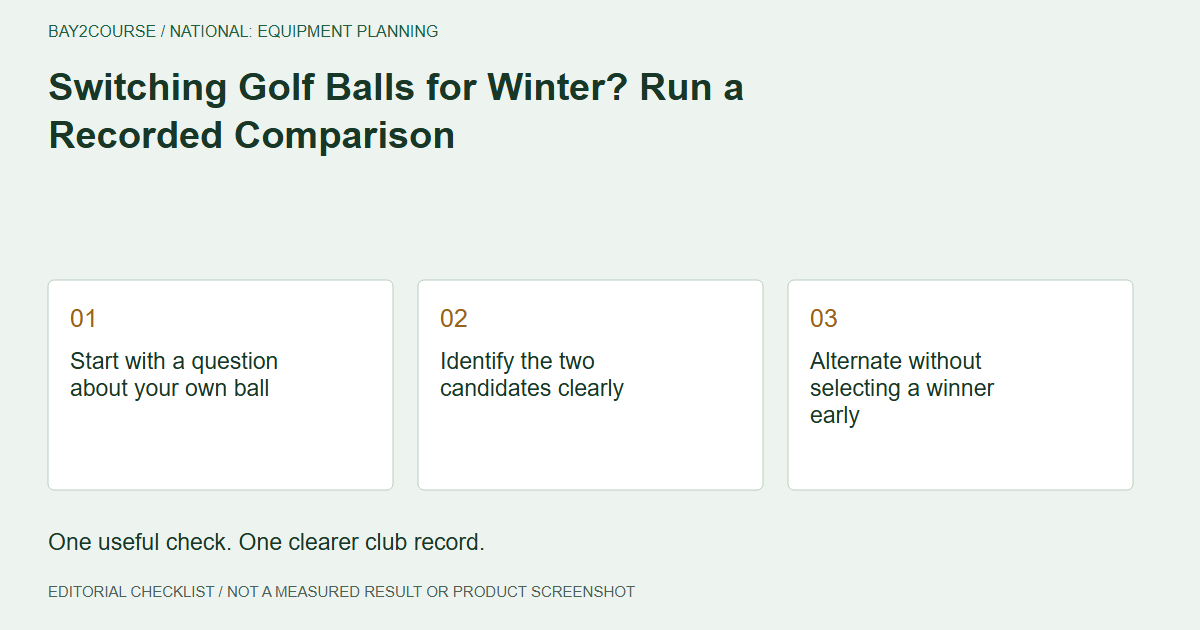
Start with a question about your own ball
A proposed winter ball change deserves a comparison, not an automatic claim of extra distance. Decide what you want to learn before buying a supply for the season. For a carry-focused check, the question might be whether the candidate produces a meaningfully different pattern in your recorded session. That is narrower than declaring a best winter ball. Carry observations alone cannot establish every aspect of performance, and they do not guarantee what will happen on your next round.
Identify the two candidates clearly
On a separate worksheet, write the exact models you are comparing, the club, the date, and the session setup. Call them Ball A and Ball B in a shared fictional example, but keep the real identities in your own record. Confirm the venue permits the balls and the proposed comparison. Check the displayed metric and units before starting. A forgotten ball identity or unexplained reporting change can make an otherwise careful-looking table impossible to interpret afterward.
Alternate without selecting a winner early
One practical comparison method is to alternate small groups using the same club and intended shot. This is an organizational suggestion, not a laboratory protocol or a required sample size. Keep the observations from both balls, including disappointing shots. Decide in advance how you will describe obvious mishits rather than deleting them only when they weaken a favorite candidate. If you change equipment or settings during the session, mark the change and avoid presenting all the results as one uninterrupted comparison.
Review the spread, not the trophy shot
Look at the number of observations and the range for each ball, as well as the session context. A single longest shot should not decide the purchase. Overlapping results may leave the question open, particularly if the shots were not comparable. Keep subjective impressions separate from the carry record. You can describe a preference, but do not treat that preference as a measured spin result or proof of better scoring. Share the uncertainty with a coach when it affects your decision.
Carry the decision into a permitted follow-up
If you choose a candidate, keep its identity visible during later course observations. Do not silently replace the ball in an established reference and then attribute every difference to the club. A fictional card note such as 'Ball B trial; course check pending' fits the 50-character limit; the full comparison belongs on a separate sheet. Revisit the choice after appropriate play, without extra unauthorized test shots. Waiting is reasonable when the available evidence does not distinguish the options.
Common questions
Must a winter ball produce more carry to be worth considering?
No. Your preferences may involve other factors, but a carry-only comparison cannot evaluate all of them. Define the question honestly instead of claiming a complete fitting.
Can I compare two balls from different sessions?
You can retain both records, but acknowledge differences in setup and circumstances. A new, better-documented comparison may be needed before attributing a difference to the ball.
Sources and further reading
Primary references behind this guide. Local course instructions and current weather take priority over seasonal averages.
Written by Bay2Course, the maker of the app. This is practical record-keeping guidance, not independent equipment testing or a claim of professional coaching credentials. How we prepare and correct guides.
Explore: gap distance calculator · trust