National: Pacific Northwest and other wet-condition rounds
Wet Winter Fairways: Do Not Turn Total Distance into Carry
Where winter surfaces are wet, a short final resting distance does not by itself establish short carry. Keep landing evidence separate from total distance and leave carry unknown when the landing was not observed.
Use this in the app: import the session, keep the clubs in Bag DNA, and compare one shot in Course Mode.
Related Golf Notes: Create a Fall Club Card Before Your Next Simulator Session · Carry vs. Total: Which Number Belongs on Your Club Card? · Normalized Simulator Distance Is Not Tomorrow's Outdoor Yardage
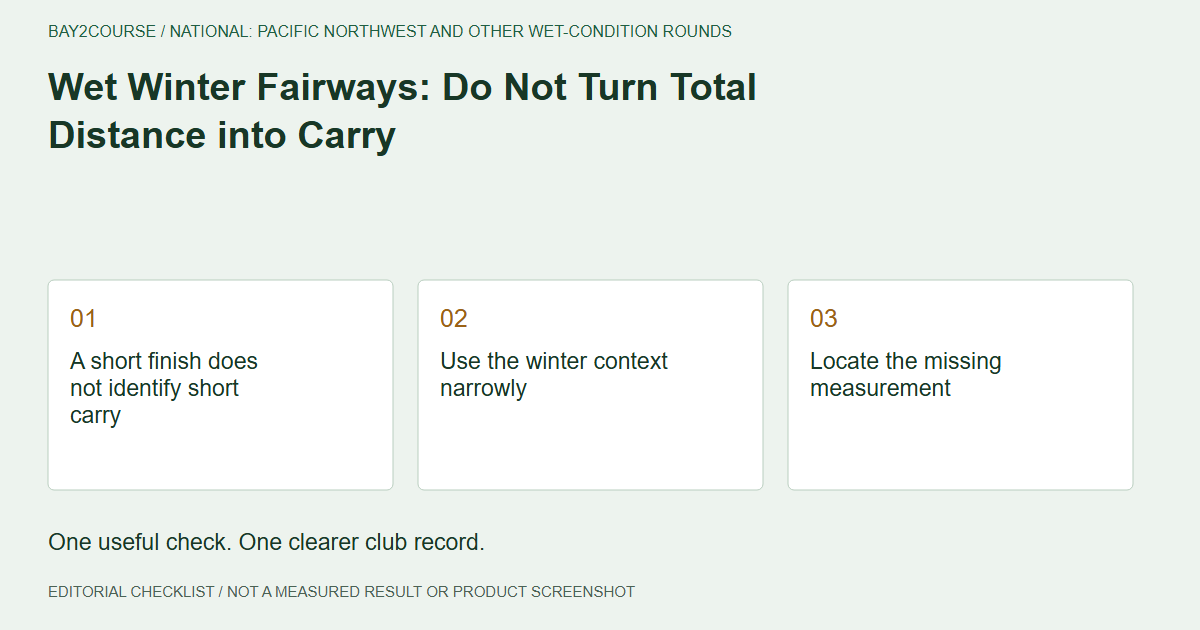
A short finish does not identify short carry
On a wet winter fairway, it is tempting to compare where the ball stops with the carry number from an indoor session. That comparison mixes two different observations. Carry ends at the landing; the final resting position comes afterward. A Pacific Northwest round is one setting where this question may arise, but the region does not establish today's surface conditions. Start with the shot you actually observed rather than assuming a standard winter distance penalty.
Use the winter context narrowly
USGA winter guidance discusses soft, wet playing surfaces and the need to manage traffic. It does not provide a formula for revising your club distances. Check the course's current restrictions and follow them, including where you may walk or drive. Do not enter a protected area to locate a landing more precisely. If gathering better evidence would require violating access instructions or interrupting play, leave the observation incomplete. The record is not more important than appropriate use of the course.
Locate the missing measurement
To describe carry, you need a defensible basis for locating the landing relative to the shot's origin. Seeing a splash or a bounce may help identify a place, but the precision of the distance estimate still matters. Finding the ball later gives you a different endpoint. Do not assume that an apparently nearby mark belongs to your shot. In the demonstration below, unknown stays unknown because the resting position alone cannot reconstruct where the flight ended.
Keep the note focused on the distinction
A fictional card note such as 'Wet fairway; total only, carry unknown' fits the 50-character limit. On a separate worksheet, preserve the club, ball, lie, surface observation, and basis for the known distance. Retain the indoor record in its original role rather than overwriting it with the shorter-looking finish. If the result still concerns you, turn it into a question for a coach: what observation would make this comparison informative enough to revisit the reference?
Wait for an appropriate opportunity
A clearer landing observation during later permitted play may answer the question; another unexplained final position may not. Repetition cannot repair the same missing evidence. Do not subtract a standard number from the simulator reference or assign a seasonal correction to the entire bag. A calculator can organize known references, but it does not convert wet-fairway total distance into carry. Review the evidence quality first, then decide whether the card needs a new observation, a clarified note, or no change.
A worked example
DEMO: Fictional evidence limits on a wet fairway, not measured shot results.
| Available information | Carry status | Appropriate description |
|---|---|---|
| Final position only | Unknown | Total-distance observation |
| Landing seen but poorly located | Uncertain | Qualified estimate |
| Landing located with distance basis | Evidence available | Record method and uncertainty |
Common questions
Can I assume the ball stopped where it landed?
Not without adequate evidence. Even when the surface looks soft, the resting position alone does not establish the landing or the precision of a carry estimate.
Is this a forecast for Pacific Northwest winter golf?
No. It is a wet-condition scenario. Check the actual local forecast and course instructions rather than assuming that any particular round will have these conditions.
Sources and further reading
Primary references behind this guide. Local course instructions and current weather take priority over seasonal averages.
Written by Bay2Course, the maker of the app. This is practical record-keeping guidance, not independent equipment testing or a claim of professional coaching credentials. How we prepare and correct guides.
Explore: how it works · trust