National: end-of-month record review
November Card Audit: Which Club Records Need a Revisit?
Review club records when equipment, measurement context, or observations change, not simply because the month ends. Keep a useful older baseline while marking the specific evidence that needs a revisit.
Use this in the app: import the session, keep the clubs in Bag DNA, and compare one shot in Course Mode.
Related Golf Notes: Create a Fall Club Card Before Your Next Simulator Session · Carry vs. Total: Which Number Belongs on Your Club Card? · Normalized Simulator Distance Is Not Tomorrow's Outdoor Yardage
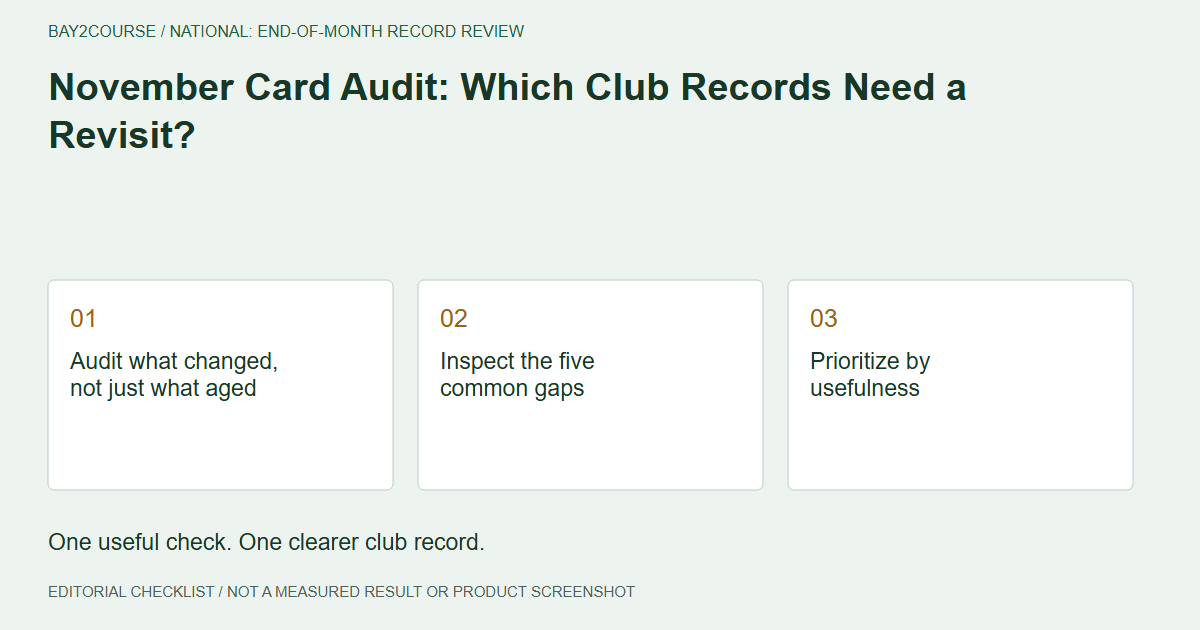
Audit what changed, not just what aged
A November card review should find records that need attention, not reset every number because the month is ending. An older reference with clear equipment and session context can remain useful. A recent number with no identifiable source may need clarification first. Start by asking what changed: the club, the ball, the reporting context, or the observations you have collected. The review should leave you with a smaller, more useful set of questions rather than a freshly rewritten but less traceable card.
Inspect the five common gaps
Check for missing dates, changed equipment, unknown session settings, conflicting observations, and unresolved coach questions. Use a separate worksheet so you can explain each issue in full. Do not assume that a new simulator visit automatically resolves an older uncertainty. If you cannot tell whether two values represent the same metric and setup, label the comparison incomplete. The point of the audit is to expose weak context before it is averaged, copied, or carried into another session as established fact.
Prioritize by usefulness
Consider three fictional records. An older iron reference still identifies its equipment and source. A recent wedge value lacks a shot description. A driver record predates a confirmed equipment change. The wedge and driver deserve different next actions: clarify the shot label for one and separate the new setup for the other. The older iron does not automatically move to the front of the queue. Age matters as context, but it is not a substitute for understanding the evidence problem.
Preserve before revising
Before editing a reference, keep its previous value and context in your own supporting record. Do not rely on an assumed automatic version history. Use the 50-character card note to identify the current question, such as 'Audit: wedge shot label missing'. Put the reason for a revision and the longer observations on the separate worksheet. That way, a future conversation can distinguish an intentional update from an accidental overwrite without requiring the short note to contain the entire history.
Leave with a short action list
Choose the next useful action for each priority: ask the venue, clarify with the coach, document the changed equipment, or seek a permitted course observation. A calculator may help organize references after their meaning is clear, but it cannot validate the underlying records. Share only the relevant questions rather than sending an unexplained audit dump. The review is complete when you know what to revisit and why, even if the actual evidence will take another session to gather.
A worked example
DEMO: Fictional audit priorities, not automated app alerts.
| Record | Issue | Next action |
|---|---|---|
| Older iron reference | Context still clear | Retain and monitor relevant changes |
| Recent wedge value | Shot label missing | Clarify the intended shot |
| Driver reference | Equipment changed | Document a separate comparison |
Common questions
Do old carry records expire at the end of November?
No automatic expiry is established here. Review the equipment, context, and later observations rather than replacing a record solely because of its age.
Should every uncertain entry be deleted?
No. Preserve the source and label the limitation where appropriate. An incomplete historical record may still provide context, as long as it is not presented as verified current carry.
Sources and further reading
Primary references behind this guide. Local course instructions and current weather take priority over seasonal averages.
Written by Bay2Course, the maker of the app. This is practical record-keeping guidance, not independent equipment testing or a claim of professional coaching credentials. How we prepare and correct guides.
Explore: trust · how it works