National
Make a Coach Note Useful at Your Next Simulator Visit
Keep the coach's instruction attributed and dated, then connect it to a specific club and follow-up question. The card stores context, not an automated swing diagnosis.
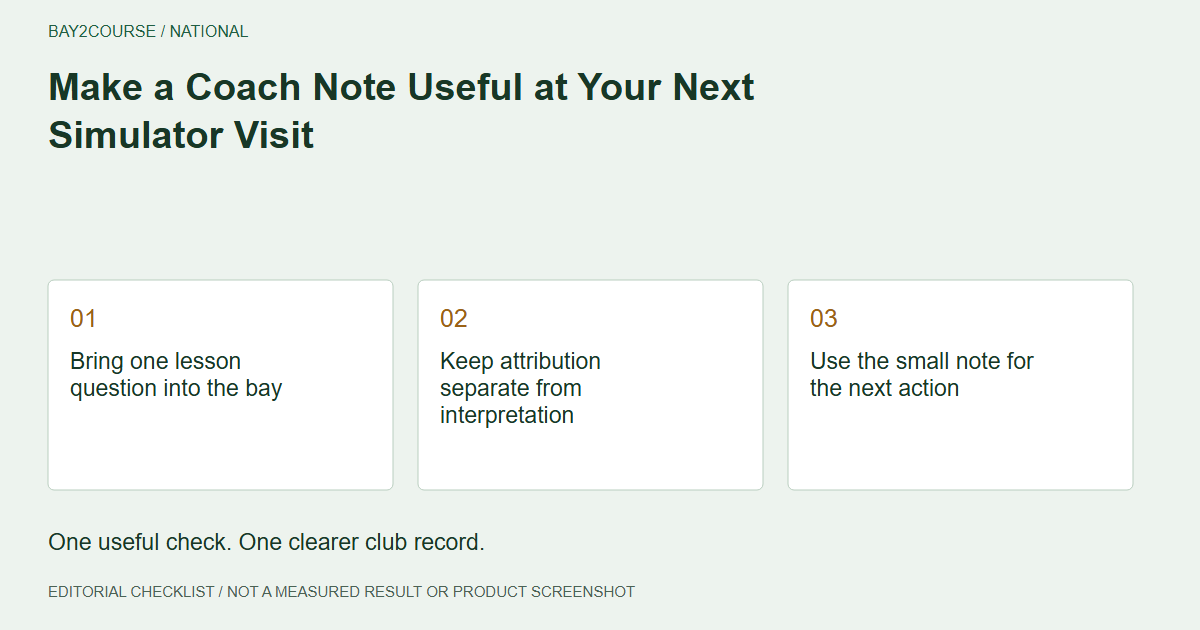
Bring one lesson question into the bay
A coach note becomes more useful when it points to something specific you can revisit. Before your next simulator session, choose one club and read the relevant lesson record. Identify what the coach actually asked you to observe rather than reconstructing the lesson from a vague memory.
This is particularly helpful when autumn practice alternates between lessons, independent indoor visits, and course rounds. The card can keep the question close to the club, while your longer lesson record preserves the context that a short note cannot hold.
Keep attribution separate from interpretation
Do not present your paraphrase as an exact quotation. If you summarize a coach's instruction, label it as your summary in the supporting record and retain the lesson date. If the original instruction is unclear, ask for clarification before turning it into a practice prescription.
For a fictional example, a golfer might summarize the next task as reviewing 7-iron carry with the coach. That does not establish a diagnosis, technique change, or expected improvement. Bay2Course records coach context; it is not analyzing your swing or issuing an automated lesson.
Use the small note for the next action
The card note is limited to 50 characters. 'Coach review: 7-iron carry question' is concise enough to serve as a reminder, with the full lesson account kept separately. Avoid abbreviating so aggressively that the next reader cannot distinguish the coach's advice from your own conclusion.
A compact note does not have to contain every observation from the lesson. Its job is to preserve the most useful prompt. When you share it, supply relevant context through the communication method you actually use rather than assuming the card has unverified attachment or messaging features.
Record what the next session establishes
Confirm the source label before evaluating the new entry. Trackman's carry explainer describes a particular metric convention; a displayed carry number is not an explanation of why a swing produced it. Keep measurement labels and coaching interpretation separate.
After the session, describe what you recorded and what remains unclear. Do not claim that a change in the displayed number proves a technique improved. An observation can be worth discussing even when the underlying reason is unresolved or the session differs from the previous one.
Share a focused follow-up
Send or show the relevant card context to your coach with one question. Explain whether the new entry came from a simulator or a course check and identify any uncertainty that could affect interpretation. Avoid sending an entire collection of unrelated numbers without a clear purpose.
A useful follow-up ends with an agreed next observation or a clarified instruction, not a promised score reduction. Revisit the card after that conversation so its brief note points to the current task rather than an old question you have already settled.
A worked example
DEMO - fictional lesson-to-session handoff; no real coach is represented.
| Record | Example |
|---|---|
| Short reminder | Coach review: 7-iron carry question |
| Supporting context | Lesson date and original instruction |
| Follow-up | Which observation should I review next? |
Common questions
Should I quote my coach in the card note?
Only when the wording is accurate and fits. Otherwise use a clearly identified summary and keep the original context separately. Do not turn an uncertain recollection into a confident attributed instruction.
Can a different carry result show that the lesson worked?
It may be something to discuss, but the number alone does not establish the cause or a lasting improvement. Share the source context and ask your coach how to interpret the observation.
Sources and further reading
Primary references behind this guide. Local course instructions and current weather take priority over seasonal averages.
Written by Bay2Course, the maker of the app. This is practical record-keeping guidance, not independent equipment testing or a claim of professional coaching credentials. How we prepare and correct guides.
Explore: for coaches · how it works