National
Keep Practice-Mode Data Separate From Virtual-Round Results
Keep practice-mode and virtual-round records separately labeled. Ask the source provider how each displayed metric is produced before deciding whether the entries are comparable.
Use this in the app: import the session, keep the clubs in Bag DNA, and compare one shot in Course Mode.
Related Golf Notes: Create a Fall Club Card Before Your Next Simulator Session · Carry vs. Total: Which Number Belongs on Your Club Card? · Normalized Simulator Distance Is Not Tomorrow's Outdoor Yardage
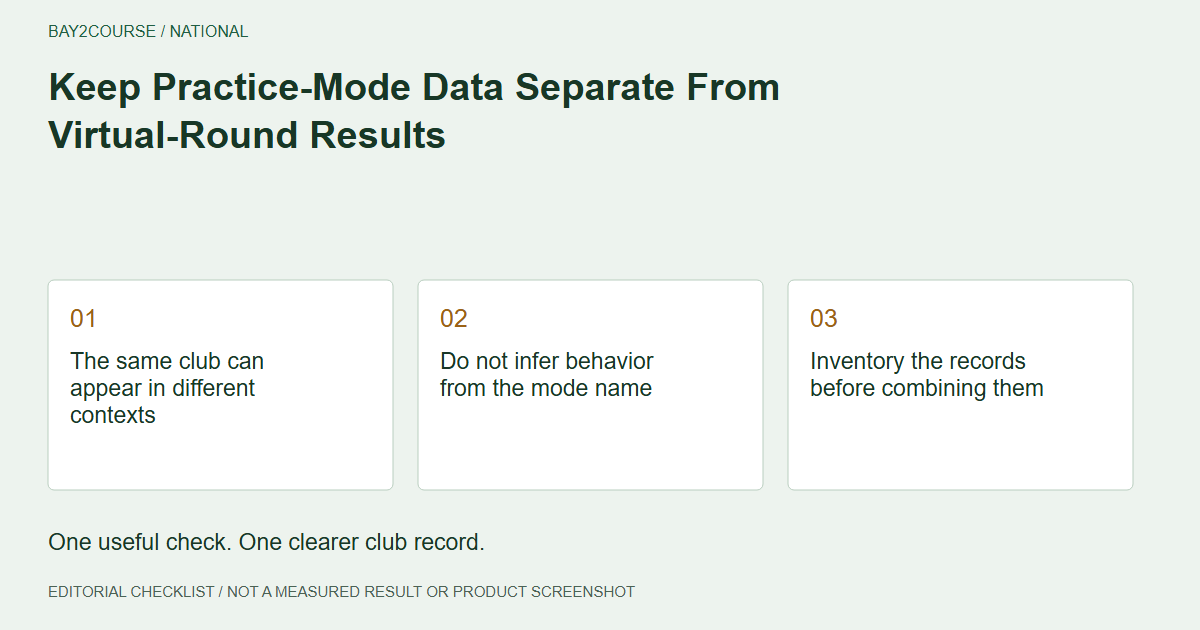
The same club can appear in different contexts
A practice screen and a virtual-round result should not automatically become interchangeable entries on a club card. Start by recording the exact mode label and the metric displayed in each. A familiar number or interface does not prove that the processing context matches.
This is an easy distinction to lose during an autumn indoor visit that begins with practice and ends with a simulated round. The sessions may share a booking, but the records should retain enough identity to show where each value came from.
Do not infer behavior from the mode name
A label tells you what the source calls the mode, not everything about how it calculates a result. Ask the provider or consult documentation for the current setup when a comparison depends on that detail. Do not generalize one system's behavior to every simulator.
Trackman's historical normalization explainer establishes a concept of modeled source conditions. It is not a complete specification for all practice modes and virtual rounds. Use it as a reason to ask careful questions, not as proof of a mode-specific rule that the source does not establish.
Inventory the records before combining them
In your own worksheet, list the date, mode name, metric label, units, and confirmed settings for each entry. Preserve unknowns explicitly. If a screenshot lacks the mode heading, try to recover the context from the original source rather than naming the mode from memory.
For the short card note, 'Practice mode; settings unknown' or 'Virtual round; context unconfirmed' fits within 50 characters. Those labels preserve a meaningful distinction while the longer inventory remains outside the card's limited note space.
Keep the unresolved example unresolved
Imagine a fictional practice entry and a virtual-round entry for the same iron. Both show a distance, but only the practice record has a confirmed carry label. You have not established that the virtual-round number represents the same metric or conditions.
Do not average them into a new baseline or select the more flattering value. Keep the second record qualified while you clarify its meaning. A separate entry with an unanswered question is more informative than a combined number whose origin can no longer be explained.
Ask what is needed for a fair comparison
A useful provider question identifies the two exact labels and asks whether they describe comparable results in that setup. Avoid asking only why one number is shorter. The answer may begin with a difference in meaning rather than a conclusion about your club or swing.
Revisit the card once the source context is understood. If comparability remains unresolved, retain the distinction and plan a better-documented future session. Bay2Course can support your recordkeeping without claiming to inspect or normalize every vendor's internal mode behavior.
A worked example
DEMO - fictional mode inventory with an unresolved comparison.
| Record | Known label | Action |
|---|---|---|
| Practice | Carry | Retain source context |
| Virtual round | Distance label unconfirmed | Ask provider |
| Comparison | Not yet established | Do not combine values |
Common questions
Can I assume a virtual round reports ordinary outdoor carry?
No. Verify the metric and processing context for the actual source. A virtual course label does not by itself establish how a displayed distance relates to an observed outdoor landing.
Should I discard all virtual-round records?
No. They may be useful when clearly identified. The caution is against combining or interpreting them as equivalent to other records before their meaning and source context are understood.
Sources and further reading
Primary references behind this guide. Local course instructions and current weather take priority over seasonal averages.
Written by Bay2Course, the maker of the app. This is practical record-keeping guidance, not independent equipment testing or a claim of professional coaching credentials. How we prepare and correct guides.
Explore: trust · how it works