Northeast: inland-to-coastal travel
Inland and Coastal Northeast Trips Need Separate Condition Notes
Do not transfer a home-course observation into a travel-course guarantee. Keep the destination's actual conditions and observations separate, and check local access before travel.
Use this in the app: import the session, keep the clubs in Bag DNA, and compare one shot in Course Mode.
Related Golf Notes: Northeast Frost Advisories Are Not Course-Opening Notices · Fall Leaves Hid the Landing: Record an Unknown, Not a Distance · Central New York and Northeast Pennsylvania: Plan a Flexible Check Window
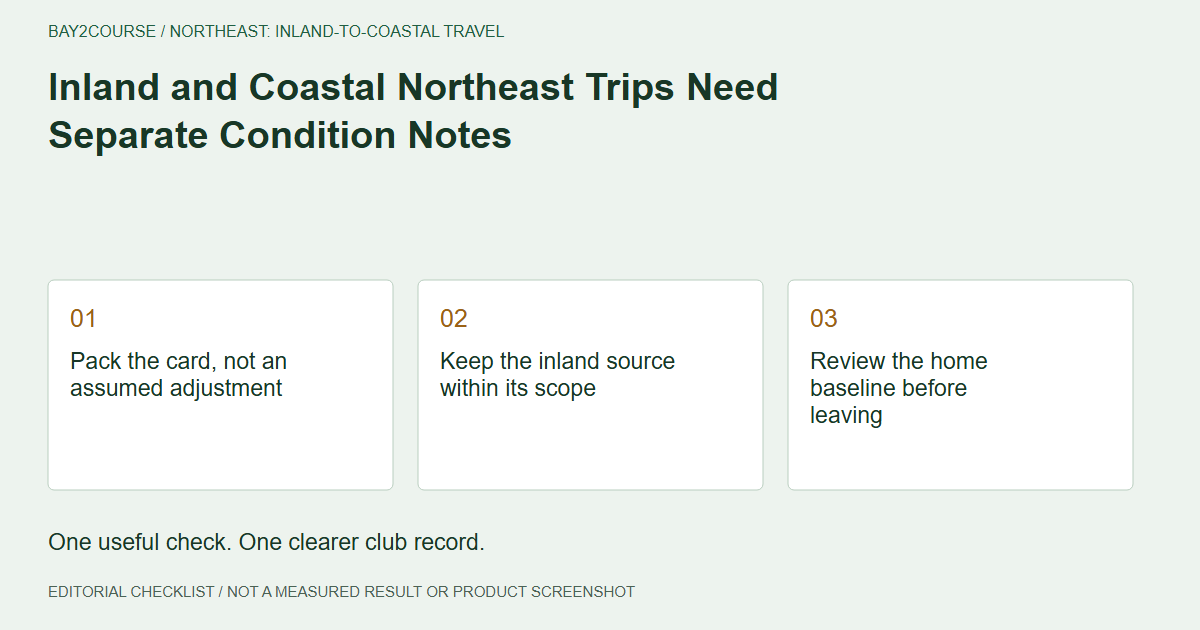
Pack the card, not an assumed adjustment
An inland-to-coastal Northeast golf trip is a reason to preserve context, not to invent a distance adjustment before you arrive. Bring the club card as a record of what you know at home. Treat the destination round as a new observation opportunity.
Do not assume the coast will be warmer, more playable, or free of delays on your travel dates. Those are local questions requiring current information. A regional description is not a forecast, and the card is not a device for calculating a guaranteed travel yardage.
Keep the inland source within its scope
The NWS Binghamton frost-program page concerns an inland service area and includes a dated program description. It cannot establish coastal weather, a destination course's opening time, or current 2026 advisory policy. Use the relevant current destination forecast instead.
Before traveling, check the course operator's notice as well as the forecast. Confirm the arrangements that affect your round. A reservation or a remembered experience from a previous autumn does not replace a current access check.
Review the home baseline before leaving
Identify the source and date of the club entry you are most likely to consult. Check its metric label and any known settings. If the value came from a normalized simulator session, retain that qualification instead of presenting it as a direct measurement of home-course performance.
Trackman's historical normalization explanation shows why modeled context deserves attention. It does not provide a Bay2Course travel conversion or a universal elevation formula. The useful preparation is understanding the starting record, not manufacturing an adjusted destination number.
Record the away round on its own terms
For a fictional example, imagine a golfer whose home note describes an unseen landing and whose away round provides a clear view. The away observation adds information, but it does not retrospectively reveal what happened at home. Keep the records separate.
A short note such as 'Away round; first landing visible' fits within 50 characters. Retain any longer destination context in your personal record. Name observed conditions rather than attributing the result to being coastal, inland, or at a different location without supporting evidence.
Compare after the trip, not during the packing
When you return, place the home and away observations beside the simulator baseline in your own review. Ask which facts are genuinely comparable and which differences remain unresolved. You may discover that the best new evidence is a clearer observation, not a changed distance.
Share a focused question with your coach if needed. Avoid declaring that a travel round proves an equipment problem or a universal regional adjustment. The card becomes more useful when it preserves the destination context without allowing location alone to become an explanation.
A worked example
DEMO - fictional home-and-away evidence comparison.
| Record | Short note | Meaning |
|---|---|---|
| Home | First landing not seen | Partial observation |
| Away | Away round; first landing visible | Separate observation |
| Review | Compare context, not location alone | Question for follow-up |
Common questions
Can I use inland frost information for a coastal trip?
Not as a destination forecast or opening notice. Use current information for the place you are visiting and confirm access with the operator. The inland source supplies only its own stated context.
Should I change my baseline before traveling?
Only if you have a defensible reason to correct the existing record, such as a mislabeled metric. Travel alone does not establish a new club distance or justify an automatic adjustment.
Sources and further reading
Primary references behind this guide. Local course instructions and current weather take priority over seasonal averages.
Written by Bay2Course, the maker of the app. This is practical record-keeping guidance, not independent equipment testing or a claim of professional coaching credentials. How we prepare and correct guides.
Explore: trust · how it works