Northeast: central New York and northeast Pennsylvania
Central New York and Northeast Pennsylvania: Plan a Flexible Check Window
Build a flexible outdoor-check window and a separate indoor task. Seasonal frost information is historical context; consult current local forecasts and the course before committing.
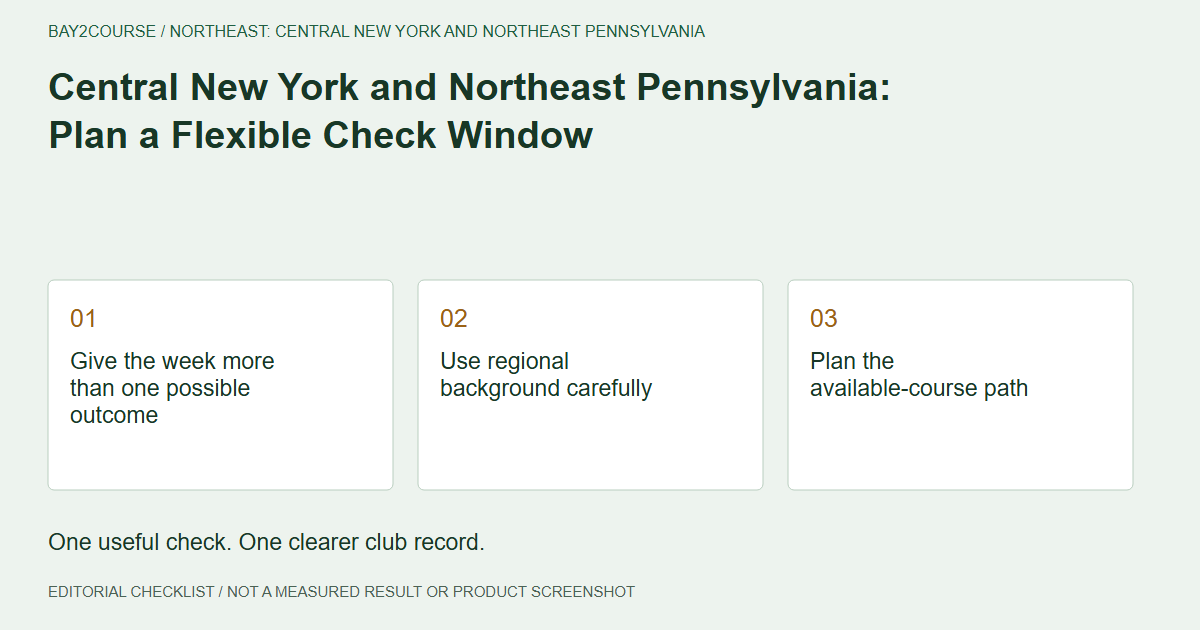
Give the week more than one possible outcome
A flexible club-check window is more useful than a single all-or-nothing appointment when you are planning autumn golf in central New York or northeast Pennsylvania. Choose an outdoor question, but also decide what you will do if the opening changes or the round offers no suitable shot.
This is not a prediction that your course will delay play. It is a way to make a limited practice schedule resilient. The card should reflect whichever task actually happened, not the task originally written on your calendar.
Use regional background carefully
The NWS Binghamton frost-program page provides historical context for its inland service area and describes a 2023 program experiment. Its old advisory dates are not a current golf schedule. Consult current destination forecasts and the course operator rather than republishing those dates as 2026 instructions.
That source also should not become a blanket claim about every Northeast course. Keep the article's regional context modest: the planning method is useful for these readers, while the actual decision remains local and current.
Plan the available-course path
If the operator confirms access, take one unresolved question into ordinary play. For example, you may want a clearer observation of a hybrid's first landing. Select the club because the question matters, not because you need another number to finish a chart.
Use a naturally appropriate shot. If you obtain a useful observation, record what was visible and retain the context in your personal record. If the opportunity never arises, do not treat merely completing the round as completion of the club check.
Plan delayed and unsuitable paths
If the opening is delayed, confirm the revised arrangements and reassess the time you actually have. A shorter outing may justify narrowing the task. If access or observation conditions are unsuitable, choose a source-review task instead, such as finding the original report's distance heading.
These outcomes deserve different descriptions. 'Opening delayed; check pending' and 'Played; no suitable club check' both fit within 50 characters. They tell a future reader why evidence is missing without implying the golfer failed or the simulator number was disproved.
Carry one question forward
At the end of the window, identify what remains unresolved and when you will revisit the decision. Keep appointment details outside the short card note. The important club-card message is the qualification that changes how its evidence should be read.
Share the specific question with your coach if it would help choose the next task. You do not need to restart the whole process after a disrupted week. Preserve the useful work and reschedule only what requires a new outdoor observation.
A worked example
DEMO - fictional three-path autumn planning window.
| Situation | Task | Honest outcome |
|---|---|---|
| Access confirmed | Observe a suitable shot | Qualified course check |
| Opening delayed | Reassess available time | Check completed or pending |
| No useful opportunity | Clarify source record | No new outdoor evidence |
Common questions
What if the course opens but the check is still unsuitable?
Access and evidence quality are different questions. Play normally, then record that no suitable observation occurred. Do not create a precise distance entry simply because the round itself was completed.
Should the backup task always be another simulator session?
No. Clarifying the original report or reviewing the coach's question may be more useful. Choose a task that resolves an actual information gap, and label it separately from outdoor work.
Sources and further reading
Primary references behind this guide. Local course instructions and current weather take priority over seasonal averages.
Written by Bay2Course, the maker of the app. This is practical record-keeping guidance, not independent equipment testing or a claim of professional coaching credentials. How we prepare and correct guides.
Explore: how it works · trust