National: golfers traveling to Southwest and Southeast destinations
Before You Pack: Build a Golf Trip Club-Card Handoff
A useful trip handoff identifies the clubs, recent carry sessions, coach questions, and missing evidence. Share that context before travel without treating the card as a GPS guide or an outdoor distance guarantee.
Use this in the app: import the session, keep the clubs in Bag DNA, and compare one shot in Course Mode.
Related Golf Notes: Create a Fall Club Card Before Your Next Simulator Session · Carry vs. Total: Which Number Belongs on Your Club Card? · Normalized Simulator Distance Is Not Tomorrow's Outdoor Yardage
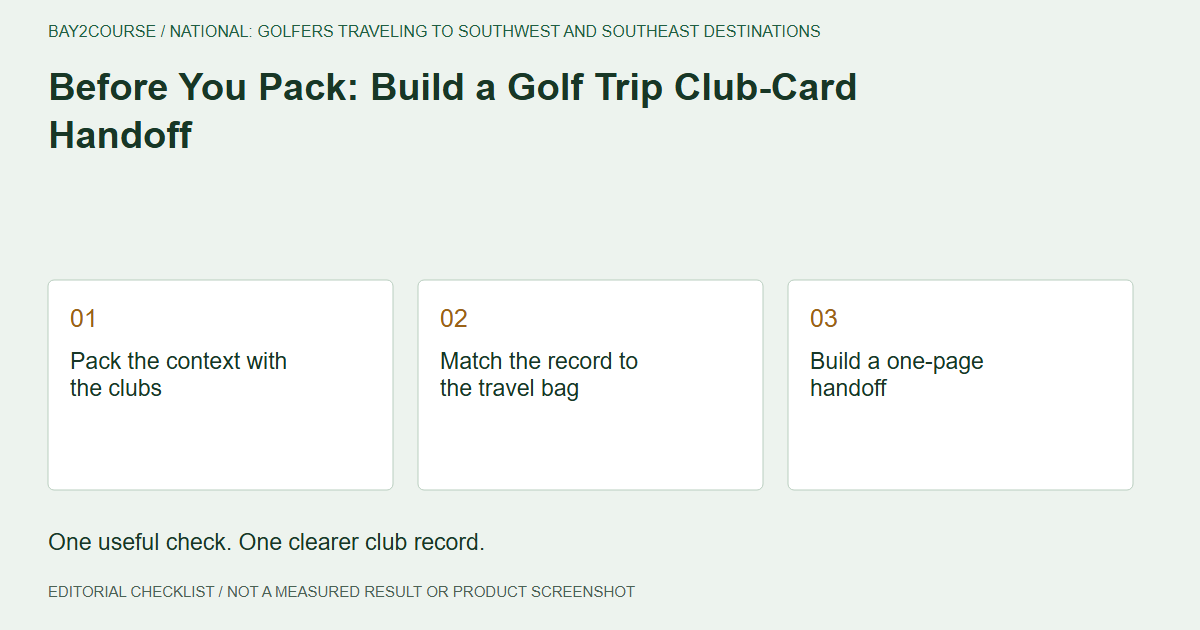
Pack the context with the clubs
A golf trip handoff starts with the equipment and records you are taking, not an accessory checklist. Before a Southwest or Southeast winter visit, gather the carry references you expect to use and identify their sources. The aim is to make your first conversation with a destination coach easier. You should be able to distinguish a familiar club with recent observations from an unfamiliar club with no evidence, without relying on memory after the travel day.
Match the record to the travel bag
Check each club against the actual bag. Flag a borrowed club, a replacement, or a wedge you decided not to bring. If you plan to rent, keep that plan separate from your home equipment reference. A useful paper inventory includes the club identity, the ball used in the baseline, and the date of the relevant session. Do not copy a home number to a different club simply because the sole carries the same number or letter.
Build a one-page handoff
Give each uncertain club a line on a separate worksheet: current reference, source date, known session context, previous coaching question, and next observation needed. Keep the sheet selective; a coach should not need to search through dozens of unexplained screenshots to find your concern. On the Bay2Course card itself, use a short pointer such as 'Trip review; confirm wedge carry'. It fits the 50-character note limit, while the worksheet carries the details that would otherwise be squeezed out.
Label what you could not confirm
Before travel, ask your regular simulator venue about any unclear metric or reporting setting. If you cannot get an answer, write unknown. Do not replace that gap with an assumption that all venues report the same thing. When meeting a new coach, explain which numbers came from the simulator and which observations came from a course. Share only the records you intend to discuss. A card does not automatically connect the two coaches or import a vendor's session.
Bring the question home again
After the trip, compare what you learned with the question you packed. Was the equipment the same? Did you obtain a visible landing observation, or only a resting position? Did the destination coach clarify the original concern? Preserve the trip context before editing a reference. If the trip used rental equipment, retain those results separately. A successful handoff can end with a better question rather than a changed number, and that is still useful continuity for the next session.
Common questions
Do I need a complete record for every club before traveling?
No. Prioritize the clubs you expect to discuss or use for a focused check. Mark missing records honestly instead of delaying the handoff until every field looks complete.
Can the card replace a destination course guide?
No. It carries club information and observations, not GPS routing or verified hole guidance. Use appropriate course information and current staff instructions for the round itself.
Sources and further reading
Primary references behind this guide. Local course instructions and current weather take priority over seasonal averages.
Written by Bay2Course, the maker of the app. This is practical record-keeping guidance, not independent equipment testing or a claim of professional coaching credentials. How we prepare and correct guides.
Explore: how it works · for coaches · trust