Southeast: central Florida
Golf After a Florida Front: Recheck Conditions, Not Every Club
Florida's dry season can still include passing weather systems. After a front, check current course conditions and collect contextual observations before deciding that a club's carry record is out of date.
Use this in the app: import the session, keep the clubs in Bag DNA, and compare one shot in Course Mode.
Related Golf Notes: Florida's November Golf Transition: What to Check Before You Play · Create a Fall Club Card Before Your Next Simulator Session · Carry vs. Total: Which Number Belongs on Your Club Card?
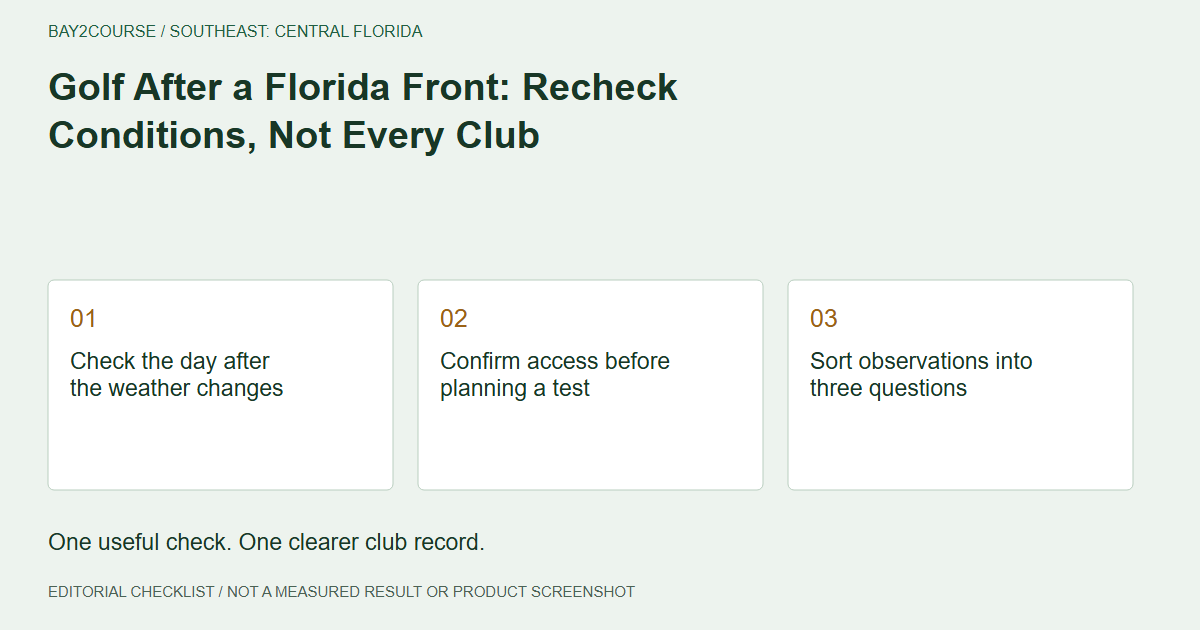
Check the day after the weather changes
A Florida front is a reason to check current conditions, not erase your distance chart. NWS Melbourne's dry-season explanation includes the role of passing weather systems. The practical lesson for a November golfer is modest: dry season does not remove day-to-day variability. Before deciding that your clubs have changed, establish what was different about the round. Keep the existing reference available while you determine whether the new observation is comparable enough to deserve a revision.
Confirm access before planning a test
Look at the destination's current forecast and the course's notices before leaving. Ask staff about opening status, practice-area availability, and any restrictions that affect your intended visit. Do not assume a front has caused a closure, or assume that yesterday's unrestricted access still applies. If the course changes the schedule, adjust your plan. The goal is a permitted opportunity to play or practice, not completing a predetermined distance check regardless of the conditions on the ground.
Sort observations into three questions
On a separate worksheet, use keep, recheck, and unknown as your own review categories. Keep an observation whose context is clear enough to retain. Recheck a result that conflicts with an established reference but has identifiable landing evidence. Use unknown when the landing, units, or other essential context is missing. These are editorial labels, not automated Bay2Course statuses. A different lie or an unseen landing should not be disguised as proof that a front changed your normal carry.
Preserve the disputed example
Imagine a fictional iron shot whose final position looks shorter than the golfer expected, but whose landing was hidden. The right record is a limited observation, not a revised carry. A note such as 'Post-front; landing unseen' fits the 50-character card limit. Keep the longer weather and course details separately. If a second shot offers clearer evidence, record that on its own terms rather than averaging the two situations into a supposedly corrected outdoor number.
Make the next check narrower
After the round, choose one club question to revisit. Confirm the ball and equipment, identify the distance basis, and ask what additional observation would help a coach interpret the discrepancy. Do not make the whole bag follow one uncertain result. If the next opportunity occurs indoors, use it to clarify the indoor reference rather than calling it a replacement for outdoor evidence. Share what changed, what stayed the same, and what you still could not establish.
A worked example
DEMO: Manual review categories for fictional post-front observations.
| Review category | Example | Next step |
|---|---|---|
| Keep | Context documented | Retain the observation |
| Recheck | Visible landing conflicts with reference | Discuss a comparable follow-up |
| Unknown | Only resting position known | Do not rewrite carry |
Common questions
Should I rebuild my card after every front?
No. Preserve useful records and investigate specific conflicts. A weather change alone does not establish that every recorded club reference needs replacement.
What if the course is open but the practice area is restricted?
Follow the restriction. Play within the course's instructions and leave the planned practice check pending rather than using a closed area or adding unauthorized test shots.
Sources and further reading
Primary references behind this guide. Local course instructions and current weather take priority over seasonal averages.
Written by Bay2Course, the maker of the app. This is practical record-keeping guidance, not independent equipment testing or a claim of professional coaching credentials. How we prepare and correct guides.
Explore: how it works · trust