Southeast: Florida coastal trips
From Inland Practice to a Coastal Round: Keep Wind Notes Visible
A coastal address does not define the wind on your tee time. Check the local forecast and record what you observe, keeping that context separate from your indoor reference instead of using a fixed coastal adjustment.
Use this in the app: import the session, keep the clubs in Bag DNA, and compare one shot in Course Mode.
Related Golf Notes: Florida's November Golf Transition: What to Check Before You Play · Golf After a Florida Front: Recheck Conditions, Not Every Club · Rental Clubs on Vacation: Keep a Separate Carry Reference
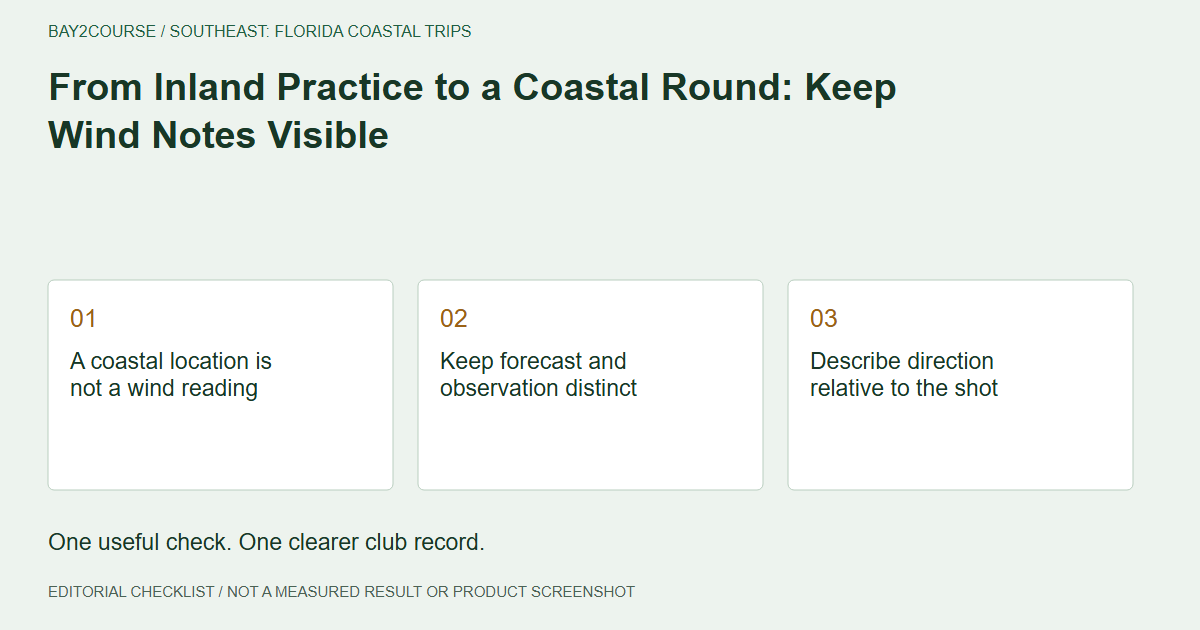
A coastal location is not a wind reading
Moving from inland practice to a Florida coastal round changes the setting, but it does not tell you the wind at your tee time. NWS Melbourne's seasonal material provides broad Florida context, not a forecast for a particular coastal hole. Check current local information before play and keep observed conditions separate from expectations. Do not label every unfamiliar result a coastal adjustment. The useful task is to describe the circumstances of a shot well enough to review it later.
Keep forecast and observation distinct
Before leaving, check the destination forecast and the course's current instructions. During play, describe only what you can reasonably observe. A forecast wind value is not a measurement at the ball, and Bay2Course should not be treated as a wind sensor. If you are unsure about direction or strength, record that uncertainty. There is no need to produce an exact value simply because a worksheet has a space for one. Leave the field qualified instead of supplying false precision.
Describe direction relative to the shot
On a separate worksheet, record the intended shot direction and a plain-language description such as wind from the left, if that was your observation. Add the club, ball, lie, and whether the landing was visible. Do not turn the description into a yards-per-wind formula. Different holes also give you different situations, so comparing two final resting positions without their context can create a misleading story. The worksheet should preserve the distinctions rather than make the entire round look uniform.
Keep the indoor reference in its own role
Suppose a fictional simulator record has documented calm-condition assumptions while a coastal shot has uncertain wind and an unseen landing. The course observation cannot establish a new carry value from that information alone. A short card note such as 'Coastal check; wind and landing unclear' fits the 50-character limit. Keep the longer explanation separately. Retain the indoor source as an indoor reference, not a forecast of the coastal shot and not a number to subtract from mechanically.
Ask a comparison question after the round
Share the limitation directly with a coach: the reference is documented, but this course observation was not comparable enough to interpret. Ask what would make a future check useful. It may be a better landing observation or a clearer description of the intended shot, not more elaborate weather calculations. Collect follow-up evidence only within permitted play or practice. A coastal visit can improve the quality of your records even when it does not produce a revised distance.
Common questions
Should I use one wind correction for the entire coastal round?
This method does not prescribe a correction. Record the actual context of relevant shots rather than treating the destination or the whole round as one wind condition.
Can I put the full weather log in the card note?
Keep the note within 50 characters and prioritize the key uncertainty. Store the longer log separately so the short note remains understandable and does not imply missing details were measured.
Sources and further reading
Primary references behind this guide. Local course instructions and current weather take priority over seasonal averages.
Written by Bay2Course, the maker of the app. This is practical record-keeping guidance, not independent equipment testing or a claim of professional coaching credentials. How we prepare and correct guides.
Explore: how it works · trust