National
A Seven-Day Card Review Without Chasing Your Longest Shot
Review what each entry establishes and what is missing. The longest recorded shot can remain in the notes without becoming the default distance for the club.
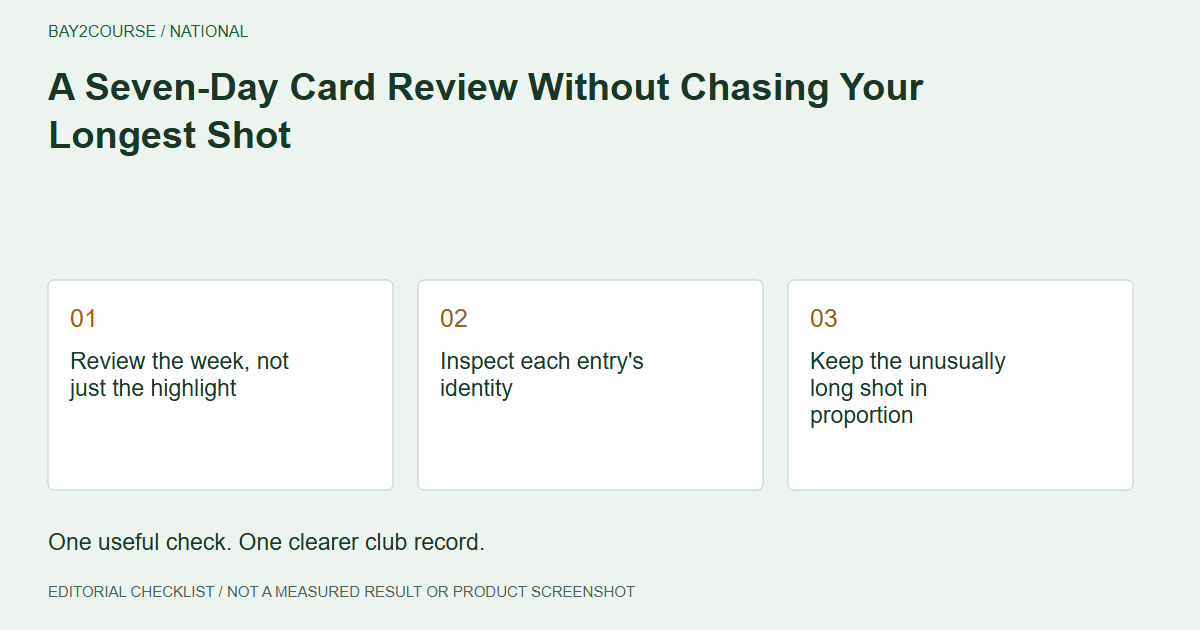
Review the week, not just the highlight
A seven-day card review should tell you what you learned about your records, not simply which shot traveled farthest. Open the entries from the week and check whether each number has a clear source and meaning. One memorable result should not silently replace the rest of the context.
For a golfer beginning an autumn simulator routine, this is an opportunity to fix small recordkeeping problems before they repeat. You do not need a complicated scorecard for the review. Three decisions are enough: what to retain, what to clarify, and what to check next.
Inspect each entry's identity
In your own worksheet, list the session or round date, club, source label, and relevant uncertainty. If the entry came from a course observation, distinguish a visible first landing from a final position. If it came from a simulator, confirm the distance label and units.
Trackman's carry explainer demonstrates that a metric has a defined meaning. Your review should preserve the source's meaning rather than treating every distance-like number as equivalent. A clear label can be more valuable than another decimal place copied without context.
Keep the unusually long shot in proportion
Suppose a fictional week contains several recorded results and one much longer shot. You can retain that event without naming it the club's new default distance. First check whether it belongs to the same source context and whether you copied the intended metric.
Do not invent a statistical threshold that makes the shot valid or invalid. This weekly review is about understanding your records, not certifying a sample. A coach may help interpret the observation, but the long result alone does not establish a lasting improvement.
Make three concrete decisions
Retain an entry whose source and meaning are understood. Clarify an entry whose report heading or units are missing. Choose a next check that addresses an actual open question, such as whether a suitable course observation can be made for a frequently used iron.
Keep those tasks in your review worksheet. Use the card's 50-character note for the key reminder, such as 'Review long shot before baseline change'. Do not assume the app automatically assigns review categories or preserves an unlimited commentary history.
Share the question, not the highlight reel
When asking your coach for help, show the relevant entry and the reason it caught your attention. Include the qualification instead of presenting only the longest value. This makes it easier to discuss what additional observation would be useful.
The review is successful when the next action is clear. More entries, a larger recorded distance, or a completed checklist do not by themselves demonstrate better golf. Revisit the card with the evidence you have, and leave unresolved items visibly unresolved.
A worked example
DEMO - fictional weekly review actions, not product status labels.
| Decision | Example task |
|---|---|
| Retain | Keep clearly labeled carry entry |
| Clarify | Recover missing report heading |
| Next check | Observe one suitable course shot |
Common questions
Should I exclude every unusually long or short shot?
Do not discard results solely because they are inconvenient. Preserve the context and identify what you do not understand. Deciding how to interpret the record is different from hiding an observation.
Does a complete week of notes prove improvement?
No. Complete records show that you documented the week. They can support a more useful review, but activity counts and note completeness are not evidence of lower scores or lasting distance gains.
Sources and further reading
Primary references behind this guide. Local course instructions and current weather take priority over seasonal averages.
Written by Bay2Course, the maker of the app. This is practical record-keeping guidance, not independent equipment testing or a claim of professional coaching credentials. How we prepare and correct guides.
Explore: how it works · trust